Satire & sourced commentary · customer trust
Coinbase Blames “Market Conditions,” Users Blame Remembering What Happened Last Time
A fictional former customer introduces a disruptive technology: memory.
SATIRE — invented characters and dialogue alongside dated, attributed reporting.
Reader-supplied satire · · 4 min read
Key findings
Fictional satire: these points describe the article’s themes and imagined scenes, not actual statements, verified events, or findings of wrongdoing.
- Bitcoin Magazine’s October 30, 2026 report described monthly transacting users falling from 9.3 million a year earlier to 7.4 million, with market conditions cited as the explanation.
- The Block’s April 17, 2025 report described a promoted Base token briefly falling roughly 95% and then recovering nearly all its lost value at publication—not a permanent loss or a current price assessment.
- Dave, the spokesperson and retention messages are invented. The idea that disappointed customers will never return is the joke’s premise, not an established cause of user declines.
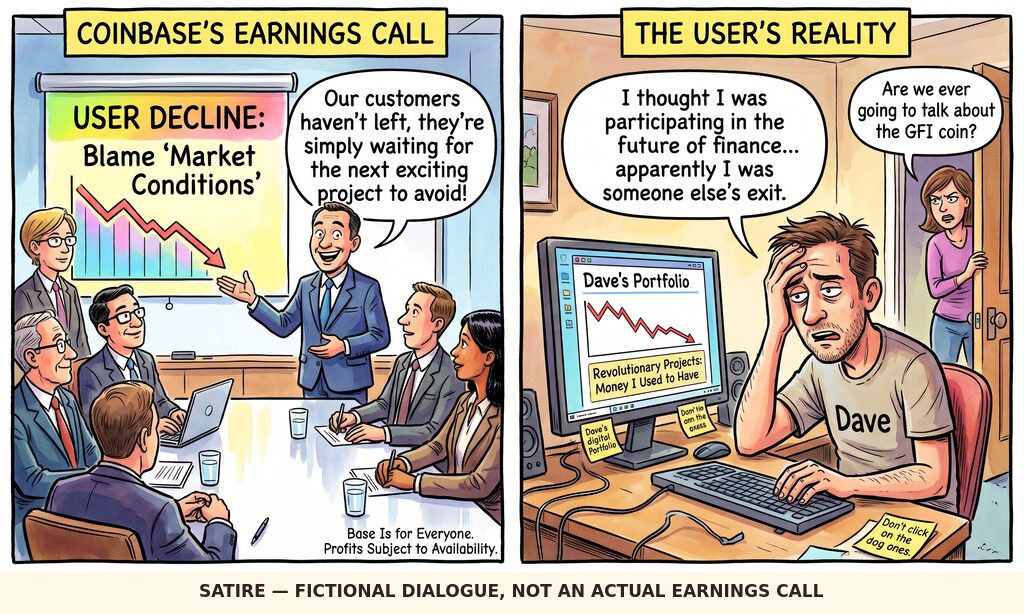
Satire. All quotations and characters below are invented, except for clearly attributed wording from the linked reports. The suggestion that departed users will never return is the joke’s premise, not an established explanation for Coinbase’s user decline.
According to Bitcoin Magazine’s October 30, 2026 report, Coinbase’s monthly transacting users fell from 9.3 million a year earlier to 7.4 million, and the company attributed the decline to overall market conditions. Apparently “people remember losing money” didn’t fit comfortably on the earnings slide.
“Our customers haven’t left,” an imaginary spokesperson explained. “They’re simply waiting for the next exciting project to avoid.”
Base Is for Everyone. Profits Subject to Availability.
For a real example behind the joke, The Block reported on April 17, 2025 that Coinbase-backed Base promoted a “Base is for everyone” token that briefly crashed roughly 95% after surging at launch. The report said it had recovered nearly all of its lost value at press time, so calling it permanently dead would be inaccurate. But the launch offered plenty of material for anyone skeptical of the next big experiment.
In our fictional customer’s portfolio, the experience got a simpler classification: “Money I Used to Have.”
“I thought I was participating in the future of finance,” said imaginary former user Dave. “Apparently, I was participating in someone else’s exit.”
Dave now keeps a folder called “Revolutionary Projects,” containing abandoned bookmarks, expired enthusiasm, and a screenshot of the exact moment he should have sold.
Your Project Isn’t Dead. It’s Community-Led.
In the parody version of the crypto economy, no project ever fails. It becomes “community-led.”
This is the stage at which the community asks where the developers went, and the developers discover a profound commitment to another project. The roadmap remains available, although every milestone has been replaced with “soon.” The chat is still active, provided you count a bot saying “Good morning, builders” to six people asking about withdrawals.
“We don’t call these dead tokens,” the fictional spokesperson clarified. “We call them long-term reminders.”
Users Discover They Can Stop
In the fictional earnings call, executives remain confident that customers will return when sentiment improves. Former customers in this fictional account have a competing theory: they lost money, disliked the experience, and are not coming back.
“I’m not waiting for regulatory clarity,” Dave explained. “I’m waiting for my wife to stop bringing up the frog coin.”
His new investment strategy involves receiving a salary and not immediately converting it into an educational experience.
Coinbase’s imaginary retention team has already tested several win-back messages:
- “We miss you.”
- “The future is still onchain.”
- “What if this one has a dog?”
- “Your remaining balance may cover a transaction.”
Dave unsubscribed after the dog.
A Difficult Quarter for Selective Memory
The fictional earnings call ended with management expressing confidence in innovation, adoption, and the possibility that customers might eventually forget.
Unfortunately, the customers had introduced a disruptive technology of their own: memory.
“We recognize that trust must be earned,” the spokesperson concluded. “Ideally through a new token launch.”
Dave closed the app.
For once, the transaction was final.
Sources and editorial context
- Bitcoin Magazine, October 30, 2026: the monthly-transacting-user figures and market-conditions explanation are attributed to this secondary report, not an independent audit of company filings. The report also described increased trading-volume share and growth in recurring revenue. A decline in monthly transacting users does not establish permanent customer departures or their reasons.
- The Block, April 17, 2025: the roughly 95% fall and subsequent recovery are historical, at-publication observations—not a current price assessment. The report says Base described the token as automatically minted through Zora and part of a contentcoin experiment. It also reported a token-description disclaimer stating no affiliation with Base or Coinbase and warning buyers not to expect returns.
Dave, the spokesperson, retention messages, portfolio and earnings-call dialogue are fictional. “Someone else’s exit” is an invented character’s line, not evidence of insider selling, fraud or a particular counterparty’s conduct. The community-led-project passage is a satirical generalization, not a factual account of Base or an identified project abandoning users.
The article’s explanation for lost customers is its comic premise, not a proven causal claim or forecast. This reader-supplied satire is opinion, not investment or legal advice, a finding of misconduct, or an actual Coinbase statement. No affiliation or endorsement is asserted.