Fictional satire · venture backing & wind-downs
The Coinbase Ventures Alumni Reunion
Satori, Goldfinch and the difference between “backed by” and “paid back”—a sourced comparison followed by an entirely fictional reunion.
By Editorial Desk · October 27, 2026 · 5 min read
Key findings
Fictional satire: these points describe the article’s themes and imagined scenes, not actual statements, verified events, or findings of wrongdoing.
- The reunion, dialogue and props are fictional; the background comparison is separately sourced.
- Satori cited insufficient revenue; Goldfinch's GIP-87 proposed a Prime wind-down and maintenance for legacy loan recoveries. These are different business models and outcomes.
- Venture backing is not a repayment guarantee. GFI token ownership, lending-pool claims and Prime redemption must not be conflated; shared investors do not establish misconduct or liability.
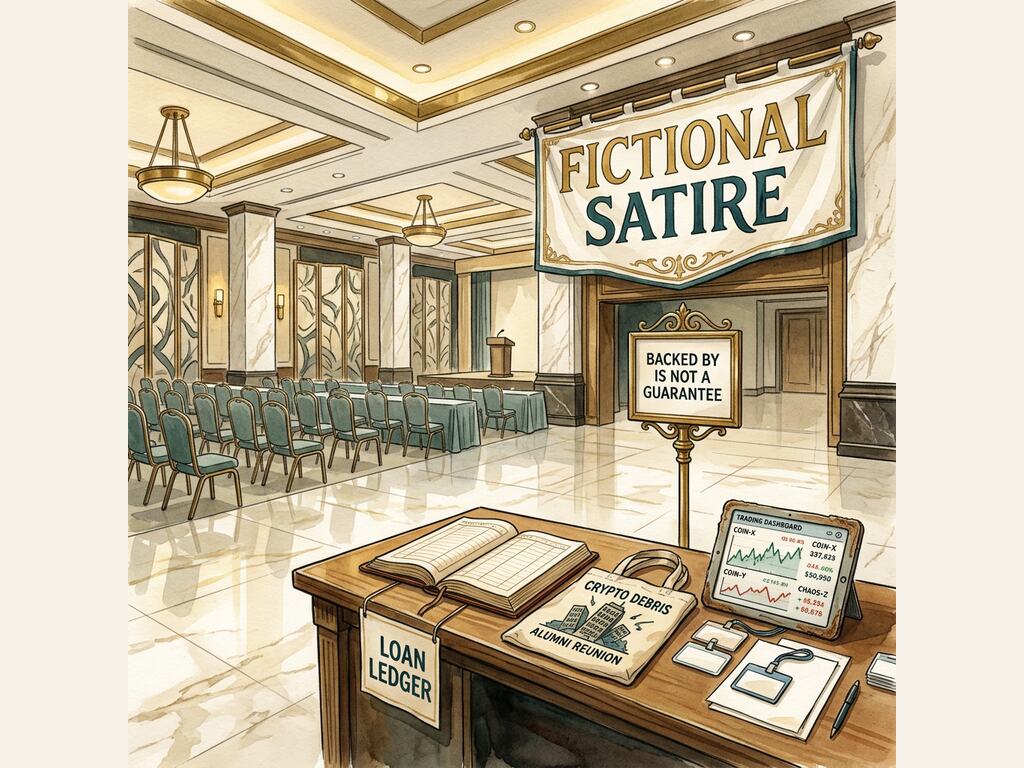
Sourced background followed by fictional satire—not an account of an actual event. All reunion dialogue, signs, props and interactions below are invented.
Satori versus Goldfinch / Warbler Labs
The Coinbase Ventures-backed project explicitly named in EGW's October 25 roundup is Satori Finance. The roundup says it closed after concluding revenue could not cover its costs. Decrypt's June 17 reporting identifies Coinbase Ventures among investors in its $10 million 2022 funding round and reproduces Satori's explanation that unfavorable market conditions left revenue insufficient to sustain operations.
Goldfinch provides a useful comparison—but GFI, Goldfinch, and Warbler Labs are different parts of the story, not interchangeable names.
| Aspect | Satori Finance | Goldfinch / Warbler Labs |
|---|---|---|
| What it built | A decentralized perpetual-futures trading platform, as described by Decrypt. | Goldfinch was a decentralized credit protocol connecting on-chain capital with real-world borrowers; Warbler Labs was its core developer, as described in The Crypto Times' June reporting. |
| Coinbase Ventures connection | Reported investor in its $10 million 2022 funding round. | Reported early investor alongside a16z and others. That investment relationship is distinct from Coinbase's exchange business. |
| Reported reason for retreat | Revenue insufficient to sustain the platform under unfavorable market conditions. | Borrower-pool performance problems and insufficient Prime adoption to justify continued investment, as described in GIP-87. |
| Reported wind-down approach | In June, users were instructed to close positions and withdraw before the planned July interface closure. This is historical reporting, not a current withdrawal instruction. | The June GIP-87 proposal called for maintenance mode, stopping new development and marketing, winding down Prime and concentrating on outstanding legacy loan recoveries while preserving legacy app access. |
| What must not be conflated | Venture funding is not evidence of sustainable operating economics. Satori's reported closure illustrates that distinction. | GFI is a governance token—not a lending-pool deposit. A GFI holder's token loss and a lender's unpaid loan exposure are different claims. Prime redemption is a separate issue again. |
Sources for the comparison: Decrypt on Satori, The Crypto Times on Goldfinch, June 23, and the primary GIP-87 governance proposal.
The common thread is not that the businesses were identical. Satori faced trading-platform economics; Goldfinch faced credit-performance and adoption problems. Both illustrate the gap between attracting prestigious investors and building a sustainable business. Neither shared backing nor a shutdown, by itself, establishes misconduct or investor responsibility for user losses.
Source limitation: The supplied EGW article identifies Satori, but does not discuss Goldfinch. The Goldfinch comparison relies on separate reporting and GIP-87. This article does not independently establish a final governance-vote outcome, completed implementation, present-day recovery balance, or the current accessibility of Satori funds. Maintenance mode is not the same as all contracts or recovery operations disappearing.
Parody: “The Coinbase Ventures Alumni Reunion”
Fictional satire inspired by the reported business models and wind-downs—not actual quotes or allegations. No such reunion is asserted to have happened.
The reunion venue was beautiful: marble floors, institutional lighting, and a banner reading:
“Welcome, Portfolio Companies. Please Validate Your Parking and Your Product-Market Fit.”
Satori Finance arrived carrying a trading dashboard.
Goldfinch arrived carrying a loan book.
Warbler Labs arrived carrying a governance proposal explaining why the loan book would now require a much smaller office.
“Who are you?” Satori asked.
“I'm Goldfinch. I brought real-world credit onto the blockchain.”
“And how did that go?”
“The credit remained remarkably real-world.”
Satori nodded. “We built a perpetual-futures platform.”
“Perpetual?”
“The futures. Not the company.”
A retail attendee approached the registration desk.
“I saw Coinbase Ventures on the investor list,” he said. “I thought that meant somebody had checked everything.”
The receptionist handed him a brochure:
“Someone investing in a company is not the same as someone guaranteeing your outcome.”
“Was that in the original pitch?”
“Smaller font.”
Across the room, GFI tried to sit at the lenders' table.
“Sorry,” said the seating coordinator. “Governance tokens over there. Loan claims over here.”
“But we all lost confidence!”
“Yes, but the paperwork is different.”
Warbler Labs took the stage.
“We are transitioning from growth to maintenance.”
“What does that mean?” someone shouted.
“The roadmap is now a collection schedule.”
Satori offered sympathy.
“We also discovered that usage, revenue, and profit are three separate dashboard tabs.”
“Which one mattered?”
“The one we should have opened earlier.”
At the end of the evening, everyone received a commemorative tote bag:
“I attended the future of finance, and all I got was a wind-down FAQ.”
The final announcement echoed through the hall:
“Thank you for joining us. Please remember: ‘backed by’ describes who invested—not who will pay you back.”
Editorial context
The “smaller font” exchange is an invented joke, not a finding that any actual pitch concealed risk warnings. The characters personify separate projects and a token; their dialogue is not a quotation from any company, employee or investor. The parody is criticism of perceived backing and business sustainability, not evidence of fraud, a guarantee, universal losses or legal liability.