Venture backing & portfolio pattern
Goldfinch, and the Quiet Graveyard of Coinbase Ventures-Backed Crypto Projects
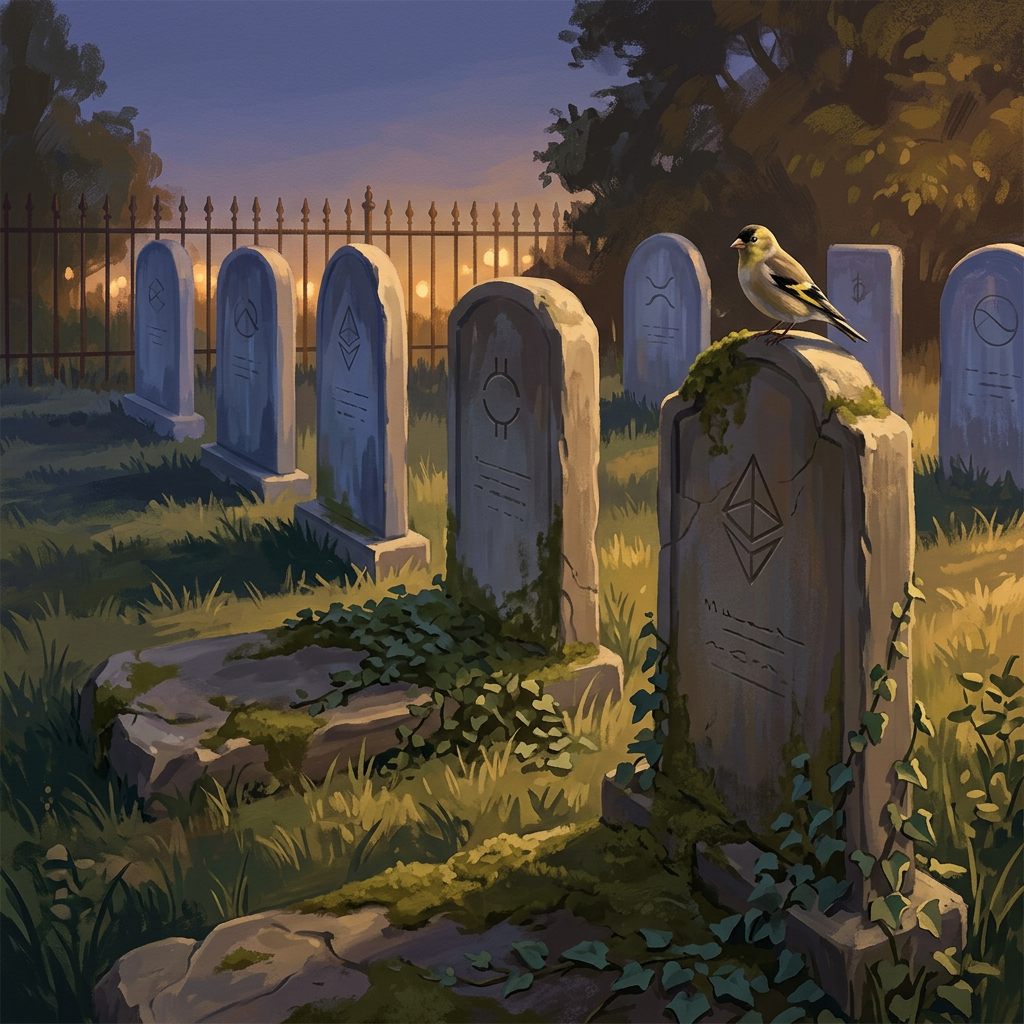
Coinbase Ventures backed Goldfinch. It also backed, or co-backed alongside a16z, at least five other crypto projects that have since wound down. Here is what happened to each one, what the pattern does and doesn't prove, and what it means if you had money in any of them.
Scope and limits: This article compiles Goldfinch's own previously documented wind-down alongside five other Coinbase Ventures- and/or a16z-backed crypto projects that have shut down since 2024, drawing on The Block, TheStreet via Yahoo Finance, Cryptonews via Yahoo Finance, The Block again, and The Block's coverage of Satori Finance, plus this site's own prior GIP-87 coverage. Grouping projects by a shared early investor does not establish coordination between them, wrongdoing by any investor, founder, or team, or that any two shutdowns share the same cause. The allegation discussed in the Goldfinch section below is attributed to its source and has not been independently verified. Nothing here is legal, investment, tax, or regulatory advice.
Every crypto bull market leaves behind a list of projects that didn't make it to the next one. What's less talked about is how many of those projects shared the same well-known venture logos on their cap table — Coinbase Ventures among them. Backing from a name like that gets used in every pitch deck and every “why you should deposit here” thread. It rarely gets mentioned again once things go quiet.
Goldfinch is the example this site has covered in the most depth, and arguably the most instructive, because its stakes were the highest of the group: real loan principal, not just a token or an app, was on the line. But it isn't the only Coinbase Ventures-adjacent wind-down. Below is what actually happened to Goldfinch, followed by five more Coinbase Ventures-backed — in two cases, jointly a16z-and-Coinbase-Ventures-backed — projects that wound down in the years around it. Not to pile on, but because the pattern across all of them is worth understanding if you have money, or had money, in any protocol carrying a big-name VC badge.
Goldfinch: Six Years, $100 Million Originated, and a Unanimous Vote to Stop
Goldfinch launched in 2021 with a genuinely different pitch for DeFi: instead of requiring borrowers to overcollateralize their loans with crypto, the way every other lending protocol worked, it would let real-world businesses — mostly fintech lenders in emerging markets — borrow against their off-chain credit history. Depositors supplied stablecoins into “senior pools” and earned yield backed by loans to businesses in places like Nigeria and elsewhere. Andreessen Horowitz led its early funding, with Coinbase Ventures also on the cap table.
For a while, the thesis looked sound. The protocol originated roughly $100 million in loans over its lifetime. Then the underlying problem with the model surfaced: several of those borrowers began defaulting, and DeFi has no easy mechanism for enforcing a loan against, say, a motorcycle-loan business in a jurisdiction with a weak legal system. This site's detailed default timeline covers the specific borrowers, dates, and amounts; restructuring dragged on for years.
The breaking point came in June 2026, when a pseudonymous depositor going by “Edward Morra” publicly alleged on X that the team had “mismanaged over $50 million” in user funds, and said that of eight borrowers in the loan book, two had defaulted outright and six were in restructuring. One day later, Warbler Labs — Goldfinch's core development team — posted GIP-87, a governance proposal to move the protocol into “maintenance mode” and wind down Goldfinch Prime, its newer product for accredited investors. The community vote passed with more than four times the required quorum and not a single vote against.
By the time the dust settled, GFI had fallen roughly 99.8% from its January 2022 all-time high, and depositors were left facing a recovery timeline measured in years rather than months, with depositors reporting realized losses closer to 70% in some pools where the protocol's own dashboard had shown around 20%. Roughly $56.15 million in loans remained outstanding against just $1.63 million in protocol value locked.
Goldfinch's story is a useful case study precisely because nothing about it was a hack or a rug pull in the classic sense — that framing is a characterization some depositors and critics have made, not a legal finding of fraud or wrongdoing. It was a real product, with real revenue, that ran into a real-world problem DeFi has never solved: you cannot code your way around a borrower who simply doesn't pay, in a country where you have no practical way to collect.
It Wasn't Alone: Five More Coinbase Ventures Bets That Didn't Survive
Goldfinch's wind-down landed in the middle of a broader stretch of closures among projects that once carried the same investor logos. This site has covered three of the five below in full elsewhere; the summaries here link out to all three.
Router Protocol — a cross-chain bridging project that raised $4.1 million in 2021 from Coinbase Ventures, Polygon, and others — announced in September 2026 that it would shut down entirely by September 30, burning more than 303 million of its ROUTE tokens from treasury, The Block reported. The team had already wound down its own Layer-1 blockchain, Router Chain, roughly a year earlier, after infrastructure costs, validator inflation, and security incidents ate into the runway. After more than four years of trying to find a buyer, a licensing deal, or a sustainable business model, none of it worked out. This site's full comparison with Goldfinch goes through the shutdown in more detail.
Legend, a mobile-first DeFi “super app” backed by both a16z and Coinbase Ventures, shut down in May 2026 — about a year after raising a $15 million seed round at an $80 million valuation, TheStreet reported. The product bundled lending, borrowing, and swapping from protocols like Aave, Compound, and Uniswap into one non-custodial interface. Founder Jayson Hobby, a former Compound Finance executive, cited an inability to reach sustainable scale rather than any dispute over funds — Legend never held user deposits itself. The full write-up covers why that makes Legend's shutdown considerably lower-stakes than Goldfinch's.
Satori Finance, a multi-chain decentralized exchange for leveraged perpetual futures, announced on June 16, 2026 that it was shutting down after concluding its trading-fee revenue could no longer sustain operations, despite processing a reported $134 billion in cumulative volume since a $10 million seed round led by Polychain Capital, with Coinbase Ventures and Jump Crypto also participating, The Block reported. Unlike Goldfinch, Satori's team said user funds remained under user control throughout the month-long withdrawal window that followed. This site's full comparison with Goldfinch goes through why the two failures have almost nothing else in common.
Entropy, a decentralized self-custody platform, raised a $25 million seed round in 2022 led by a16z, with Coinbase Ventures, Dragonfly Capital, and several other funds also participating. It wound down in January 2026 after several pivots — most recently into an AI-driven crypto automation platform — when founder Tux Pacific said an investor-feedback round had revealed the business “wasn't venture scale.” Pacific wound the company down rather than pivot again, returning remaining capital to investors.
Qredo, a crypto custody platform, raised an $80 million Series A in 2022 led by 10T Holdings, with Coinbase among the strategic investors. Roughly two years later, in February 2024, Qredo was placed into administration following a leadership shake-up — its CEO had been removed months earlier amid a debt-financing restructuring — and further layoffs. Its remaining assets were acquired by 10T Holdings' own new entity, Fusion Labs, and relaunched under a different name, on a different chain.
The Pattern Underneath All of It
None of these five followed the same script as Goldfinch — no single one involved defaulted real-world loans — but they share a shape:
- A credible thesis, backed by credible investors, at the top of a funding cycle.
- A working product that never found a large enough or sustainable enough user base to justify its costs.
- A wind-down announced on the team's own terms, framed carefully, months or years after the warning signs were visible to anyone paying close attention to on-chain data, governance forums, or token price action.
Venture backing tells you a fund believed a team was worth a bet at a specific point in time. It has never been, and isn't now, a guarantee that the product works, that the token holds value, or that a deposit comes back. Goldfinch's own token holders voted unanimously to end the protocol — the people closest to it saw the writing on the wall before most depositors did.
A caution on the pattern itself: these six cases are highlighted here because they are documented and sourced, not because they are a random or representative sample of either fund's portfolio. This site has previously flagged an unverified, secondhand estimate that roughly 30 Coinbase Ventures-backed projects have had tokens trade on Coinbase; that figure was not independently confirmed there and isn't confirmed here either. Both a16z and Coinbase Ventures have backed hundreds of companies between them, the large majority of which have not shut down or drawn public criticism, and a16z in particular invests across nearly every corner of technology, not just crypto — which makes a handful of failed crypto bets an even weaker signal about that firm specifically. None of this establishes coordination, common wrongdoing, or legal responsibility by any investor, founder, or team named above.
If You Had Money in Goldfinch or a Similar Protocol
If you're reading this because you had funds in Goldfinch's senior pools or in Goldfinch Prime, a few things are worth knowing:
- The wind-down under GIP-87 does not erase outstanding loans — Warbler Labs' stated plan is to keep pursuing recovery on the roughly $56 million still owed, which means any return of funds will likely happen gradually and partially, not all at once.
- Prime investors, who went through a separate, KYC'd fund structure, were expected to be redeemed under the wind-down plan — check the specific communications you received from Warbler Labs or your onboarding platform.
- Documentation matters. Deposit records, transaction hashes, dates, and any communications you received from the team are worth preserving now, regardless of what path you decide to pursue.
This isn't legal advice, and every situation is different — talk to a professional if you're weighing formal options.
This piece is part of an ongoing series tracking what happens after the funding announcements — the shutdowns, wind-downs, and quiet defaults that rarely get the same headlines as the raises did.
This piece draws on Warbler Labs' GIP-87 proposal and GoldfinchClaims' own prior reporting on Goldfinch's wind-down, plus The Block's coverage of Router Protocol, TheStreet's coverage of Legend, Cryptonews' coverage of Entropy, The Block's coverage of Qredo, and The Block's coverage of Satori Finance. The allegation attributed to “Edward Morra” is exactly that — an allegation from a pseudonymous source, not an independently verified fact. Sharing an early investor is not evidence of coordination, and nothing here alleges wrongdoing by Warbler Labs, Andreessen Horowitz, Coinbase Ventures, Router Protocol, Legend, Entropy, Qredo, Satori Finance, or any named individual. Nothing here is legal, investment, tax, or regulatory advice.