Fictional satire & commentary
My bank Warns Me Before a $1 Zelle. Coinbase Lets Me Buy $30,000 of GFI
A fictional satire about payment warnings, crypto purchase screens, venture-capital logos, and the difference between recognition and due diligence.
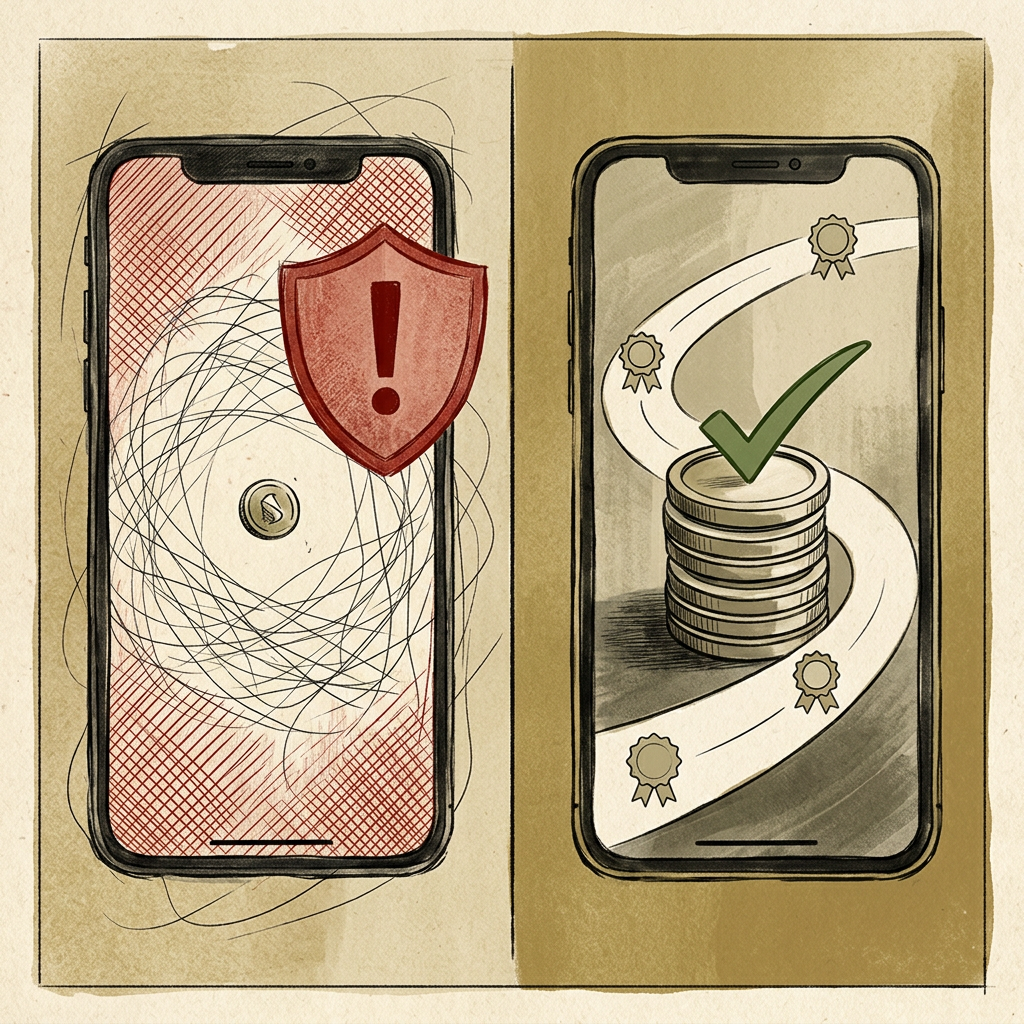
Fictional satire: The narrator, dollar amounts, dialogue, and transaction sequence are invented for commentary. This is not a factual account of a particular Coinbase purchase, Zelle transfer, warning screen, or person. Consumer prompts vary by institution, product, user, and time. References to real companies and products provide context, not an allegation of wrongdoing or a statement that any platform was required to prevent a purchase.
The one-dollar emergency
I tried to send a friend $1 on Zelle. Immediately, my fictional bank sprang into action like I was attempting to wire the national treasury to a deposed prince.
Are you sure you know this person? Scammers may pressure you to send money. Payments may be irreversible. Please confirm this is not someone named “Definitely Not a Scam LLC.”
Frankly, I appreciated the concern. One dollar is serious business. You could buy almost a quarter of an airport bottle of water with that kind of money.
30,000 dollars of vibes
Later in this invented afternoon, I opened Coinbase and bought $30,000 worth of Goldfinch's GFI token. No fictional pop-up asked whether I understood smart-contract risk, liquidity risk, governance-token risk, regulatory risk, token-unlock risk, market-maker risk, or the classic “the chart looked bullish at 2:17 a.m.” risk. Instead, the imaginary interface gave me a pleasing green button labeled “Buy.”
Fictional Me had reasons. Public materials had referenced prominent early investors, including a16z and Coinbase Ventures. Naturally, I interpreted their presence as a personal financial guarantee addressed specifically to me. Not legally, of course. But spiritually.
The investor-safety hierarchy
- Sending $1 to your cousin: extremely dangerous.
- Buying a latte: potentially catastrophic.
- Purchasing a volatile crypto asset after recognizing famous names in an old funding announcement: frictionless consumer empowerment.
- Seeing a venture firm's logo near a project: emotionally equivalent to receiving personalized investment advice from the Federal Reserve.
Payment transfers may be irreversible. Crypto trades, on the other hand, are famously reversible once you notice the token is down 87%.
The warning I needed
Caution: An early investment by a prominent fund does not mean this token will rise in value. Venture investors may have acquired assets at different prices, under different terms, with different liquidity options, vesting schedules, or hedges. Your purchase may be based partly on logo recognition and a deep emotional need for the green candle to continue.
Then a checkbox: “I understand that ‘backed by’ is not the same thing as ‘endorsed for me to buy at today's market price.’” Then one final question: “Would you still like to proceed after viewing a chart of similar tokens launched during the last bull market?”
I probably would have clicked Yes. But at least we could have done it together.
The serious point
The joke is not that adults should be prevented from buying crypto. Adults should be allowed to make informed decisions, including spectacularly expensive fictional ones. The joke is the difference in friction.
If a financial app can pause a $1 payment to ask whether the recipient is trustworthy, a digital-asset platform could also explain—clearly and at the moment of purchase—that venture backing is not a warranty, an exchange listing is not a price target, and a familiar logo is not transaction-level due diligence.
The warning would not eliminate risk. It would simply put the risk closer to the green button instead of several links away in the fine print.
It is not due diligence. It is due-logo-ence.