Fictional parody · trading links & accountability
The Conveniently External Exchange
An imaginary trading portal, a very articulate exchange and an investor left reading the risk disclosure.
Key findings
Fictional satire: these points describe the article’s themes and imagined scenes, not actual statements, verified events, or findings of wrongdoing.
- The fictional exchange parodies a platform enabling easy market access while describing resulting losses as someone else’s responsibility.
- Invented explanations contrast the trader’s experience with contractual distinctions between platform operations and user-directed risk.
- The parody’s chart and dialogue critique fee incentives without establishing an actual exchange policy or wrongdoing.
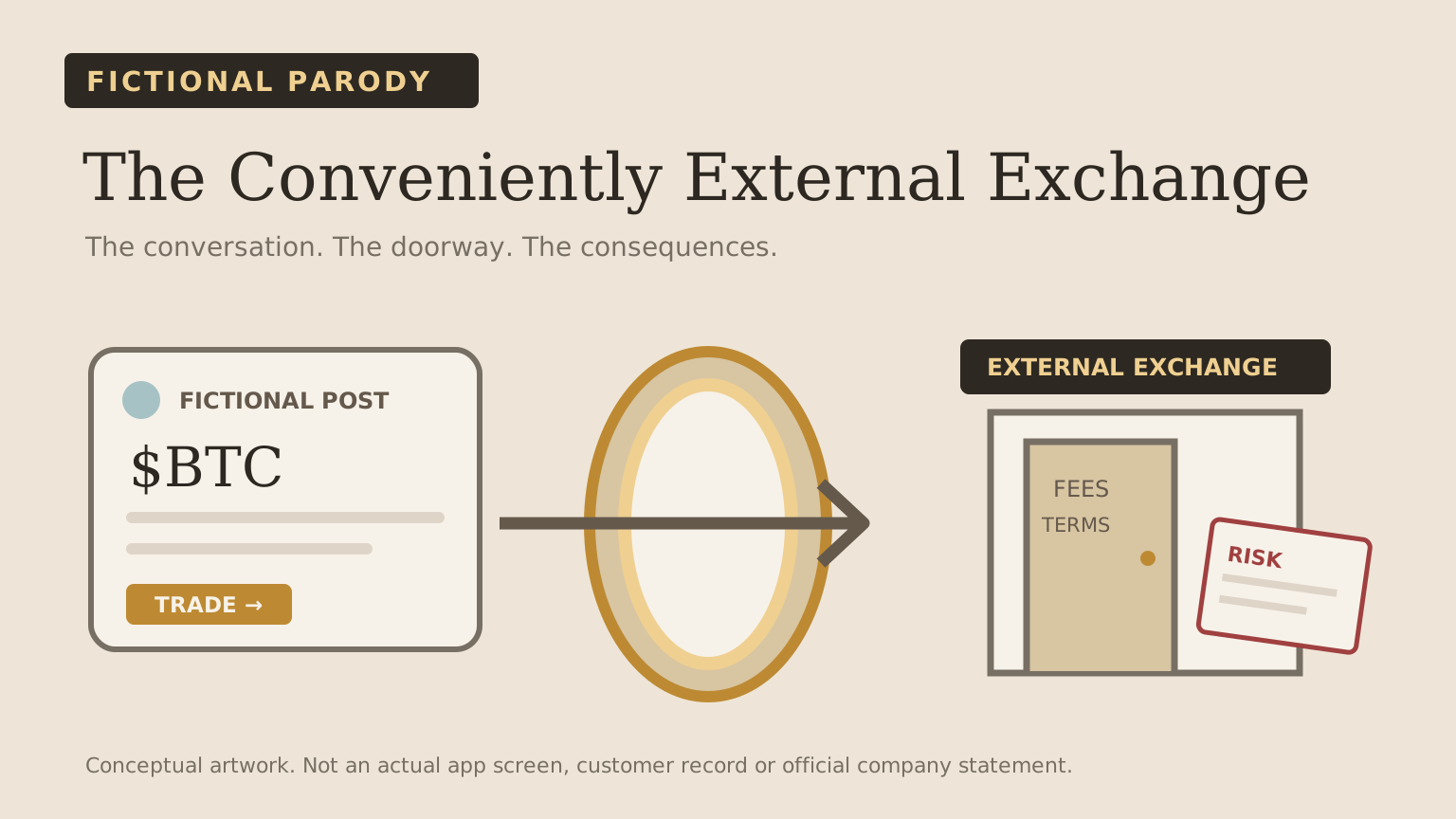
Clearly fictional parody with attributed reporting in the closing note. All exchange and investor dialogue, the spokesperson, Customer Experience Journey table and public statement are invented—not actual company quotations, policies or customer records. The story criticizes perceived incentives and risk allocation; it does not allege theft, fraud or other misconduct by Coinbase, X, Kraken, Gemini, Interactive Brokers, Moomoo or any other company. References to 47 pages, 3:14 a.m. and section 19(b) are narrative details, not verified disclosures or records. The fiction does not establish actual fee arrangements, legal liability or the availability of trading links for every cashtag. No affiliation or endorsement is asserted.
Here’s a clearly fictional parody that criticizes the incentive structure without asserting that Coinbase actually steals customer money.
Parody: “The Conveniently External Exchange”
In a completely fictional universe, X introduces one-click trading links under every cashtag.
You see `$BTC` trending beside a post from someone named “DefinitelyNotFinancialAdvice,” tap Trade, and are transported through a glowing portal to an exchange.
“Welcome,” says the exchange. “We are not responsible for the tweet that made you buy. We are merely the convenient doorway, the account custodian, the order-routing venue, the fee collector, the spread discoverer, the volatility explainer, and—when the chart turns red—the thoughtful provider of a 47-page risk disclosure.”
The investor asks, “Wait, where did my money go?”
The platform adjusts its tie.
“Your money did not go anywhere. It participated in a dynamic market event facilitated through a seamlessly integrated ecosystem of external links, liquidity conditions, user-directed actions, and terms you accepted at 3:14 a.m.”
“But the app made it look like I could trade directly from X.”
“Correct. X displayed the conversation. We supplied the button. You supplied the capital. The market supplied the consequences. Everyone played an important role.”
“What about my loss?”
“Ah,” says the exchange, stepping backward behind the word exchange. “Losses belong to the investor. Fees, naturally, belong to the platform. This is what we call decentralized accountability.”
A spokesperson then appears with a chart labeled Customer Experience Journey:
| Stage | What the investor sees | What the platform sees |
|---|---|---|
| Bull market | “I’m a genius” | Trading volume |
| Deposit | “Getting started” | Available funds |
| Buy | “To the moon” | Transaction fee |
| Sell during crash | “Why won’t it fill?” | Market conditions |
| Complaint | “Where is support?” | Ticket received |
| Loss | “Who is responsible?” | Risk disclosure, section 19(b) |
Finally, the exchange issues a public statement:
“We take user protection seriously. That is why we provide multiple warnings, several confirmations, and an easy-to-find link explaining that, in the event of loss, the investor has always been the final and most important risk-management department.”
Moral: In the fictional casino of frictionless finance, the social platform owns the hype, the exchange owns the fees, and the investor owns the downside.
Note
The article says X’s cashtag feature directs U.S. users to partner platforms such as Coinbase, Kraken, Gemini, Interactive Brokers, and Moomoo; X itself does not execute trades or custody assets. The parody above is commentary on perceived accountability and risk allocation, not a factual allegation of theft by Coinbase or any other company. coincentral
Source context and verification
- The contextual note is attributed to CoinCentral’s September 22, 2026 report, reviewed October 3, 2026. It describes U.S. users following supported cashtag trading links to external providers, where transactions take place. This is attributed reporting, not an independent test of current availability, every provider’s terms or any specific transaction.
- The portal, fictional account, dialogue, spokesperson, comparison table and public statement are invented. They are not actual quotations, interface screenshots, fee schedules, customer records or company policies. “Under every cashtag” and “one-click” are fictional exaggerations, not verified descriptions of supported assets or the full trading process.
- The moral is commentary on incentives, not a legal conclusion that investors always bear all losses or that platforms have no duties or liability. Responsibility can depend on applicable law, conduct, account terms and the facts of a particular transaction.