Fictional satire · marketplace comparison
eBay vs. Coinbase: A Marketplace Parody
A $12 phone case, a $12,000 token, and two very different rituals of buyer confidence.
By Editorial Desk · · 5 min read
SATIRE: Adapted from reader-supplied content. Shopping anecdotes, token-project mishaps, and imaginary platform voices are exaggerated fictional scenarios, not reports about real transactions or allegations of wrongdoing. Policy references are identified separately; the Coinbase risk statement cited applies to Canada. Not investment, legal, tax, or regulatory advice.
Key findings
Fictional satire: these points describe the article’s themes and imagined scenes, not actual statements, verified events, or findings of wrongdoing.
- The marketplace parody contrasts detailed scrutiny of ordinary purchases with an imagined frictionless token-buying experience.
- Fictional shoppers highlight differences between seller reviews for physical goods and the information available to token buyers.
- Exaggerated mishaps question whether prominent risk warnings can substitute for understandable product information and accountability.
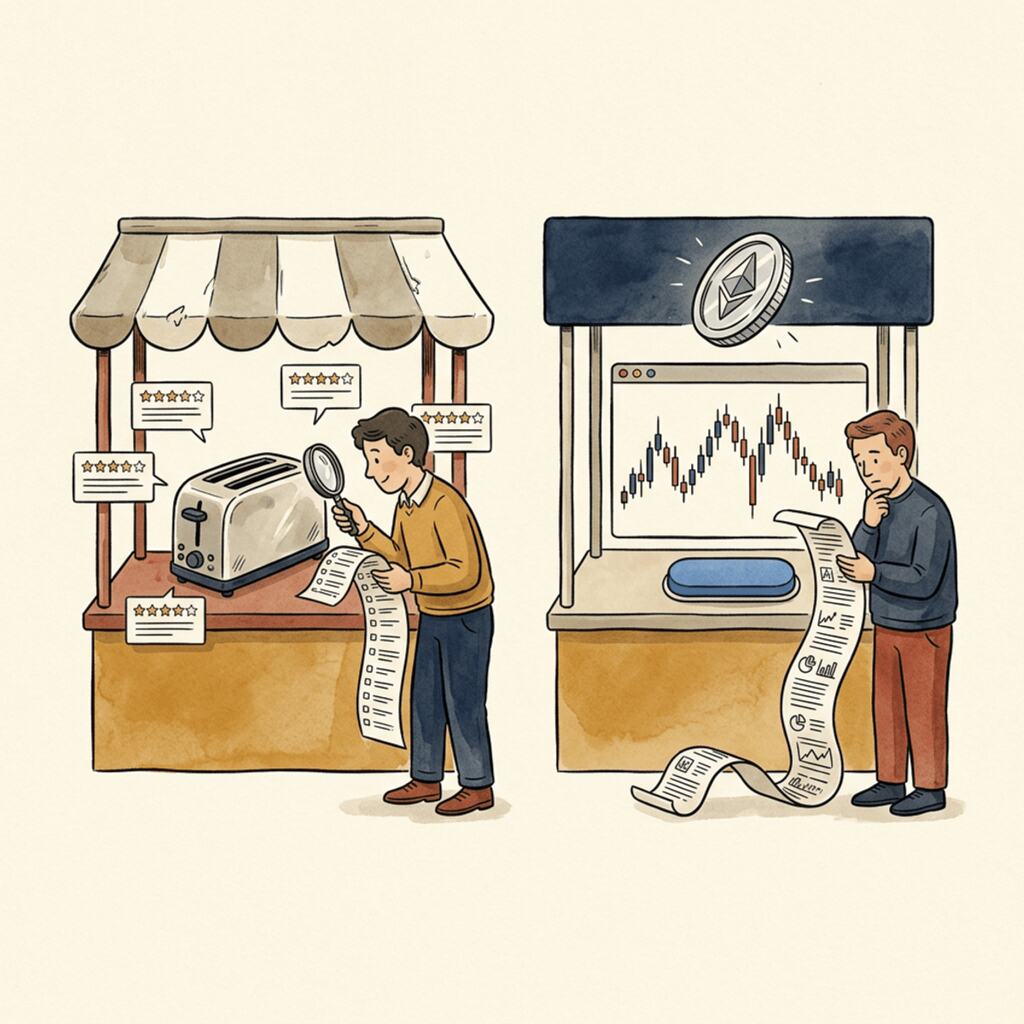
On eBay, buying a $12 phone case feels like applying for a mortgage. On Coinbase, buying a $12,000 token can feel like tapping a bright button that says, “Yes, I would like financial consequences.”
This is a marketplace parody, not a literal audit of either platform’s interface. The imaginary purchases, disappointed customers, and token-project mishaps below are comic scenarios, not reports about a particular seller, issuer, or transaction.
The eBay ritual
As an eBay buyer, you begin with due diligence worthy of a corporate acquisition:
- You read the seller’s profile, feedback percentage, and the tragic saga of “Item arrived late, but seller apologized with a handwritten note.”
- You inspect 47 photos of a used blender, including one taken at an angle that suggests the seller owns exactly one lamp.
- You compare listings, read reviews, check return policies, and ask: “Is this the 2021 model or the one that makes a noise like a haunted dishwasher?”
- After purchase, you leave feedback: positive, neutral, or negative, often with photos and a review that future buyers will treat as sacred text. eBay’s policy is designed to make feedback meaningful to buyers and sellers, subject to its moderation rules. eBay Feedback policies
The marketplace says, in the parody’s imaginary voice: Here is the seller’s history. Here is what other buyers experienced. Here is a way to complain if the toaster arrives as a toaster-shaped box of disappointment.
The Coinbase ritual
In the parody, the Coinbase experience is more streamlined:
- There is no used-goods seller profile to interview—only an asset, a price chart, and your own optimism. That does not mean a crypto trade has no counterparty.
- There is no “98.7% positive feedback” score for a token’s investment performance. There is only a candlestick chart that looks like a seismograph during an earthquake.
- Instead of asking a blender seller about the model number, you research whether a project team actually shipped its product. In our imaginary example, the product may be a whitepaper, a Discord server, and a roadmap that ends at “Phase 4: Ecosystem.”
- After buying, there is no equivalent of leaving the fictional token one star because its founder disappeared, its liquidity vanished, or its “revolutionary utility” turned out to be a JPEG with a roadmap. These are invented scenarios, not allegations about a listed asset.
Coinbase does publish risk disclosures. Its Canadian Crypto and Staking Risk Statement says cryptocurrencies are highly speculative and buyers may lose some or all of their money; it also discusses limits on investor-compensation protection. That document is specific to customers receiving services from Coinbase Canada and should not be treated as a universal statement of every customer’s rights. It describes asset review and asset-specific disclosures as well. But the parody remains: the imagined buyer-facing experience is closer to “press Buy” than “interview the merchant.” Coinbase Crypto and Staking Risk Statement — Canada
The buyer’s journey
The table mixes sourced policy summaries with deliberately exaggerated comic descriptions—not a comprehensive comparison of platform features or remedies.
| Step | eBay | Coinbase |
|---|---|---|
| Before purchase | Research the seller’s feedback score and history. eBay Seller ratings | Research the token yourself; the chart is the personality test. |
| Product information | Photos, specifications, condition, shipping details. | Whitepaper, tokenomics, community posts, and hope—in the parody’s shorthand. |
| Trust signal | Seller rating and detailed feedback. eBay Seller ratings | Market capitalization, listing status, and vibes. None guarantees investment returns. |
| After purchase | Leave feedback about your purchase and seller. eBay Feedback policies | In the joke, leave feedback on X, where it becomes content rather than a seller-rating control. |
| If something goes wrong | Open a case, request a return, possibly get a refund, subject to applicable policies and eligibility. | In the fictional trading-loss scenario, check whether the asset still has liquidity, then reconsider your life choices. |
| Platform message | Feedback should be meaningful for buyers and sellers. eBay Feedback policies | Cryptocurrencies are highly speculative and you may lose some or all of your money. Coinbase Crypto and Staking Risk Statement — Canada |
Buying a physical item and trading a volatile asset are different activities. eBay feedback is not a guarantee of a good purchase; Coinbase’s risk disclosures do not mean customers have no support, complaint channels, or legal rights. A change in a token’s market price is not the same issue as an incorrectly described toaster.
The punchline
eBay treats you like a customer buying from another human who might send the wrong color sneakers.
In the parody, Coinbase treats you like an adult entering a global, 24/7, volatile financial arena where the “seller” may be an anonymous development team, the “product” may be a smart contract, and the “return policy” is whatever the market decides at 3 a.m.
On eBay, the imaginary warning label is: “Seller has 99.2% positive feedback.”
On Coinbase, the risk statement’s warning is: “You may lose some or all of your money.” Coinbase Crypto and Staking Risk Statement — Canada
One is a marketplace with reviews. The other, in this deliberately simplified joke, is a marketplace with a risk disclosure, a chart, and a button that says Buy.
Sources and parody boundaries
- eBay Feedback policies explains feedback’s purpose and moderation. It supports the feedback-policy discussion, not the invented shopping anecdotes or an unconditional refund guarantee.
- eBay Seller ratings explains feedback scores and detailed seller ratings. Seller feedback is not a guarantee of product quality.
- Coinbase Crypto and Staking Risk Statement — Canada supplies the risk background for Canadian customers. Protections and applicable terms vary by jurisdiction; this article does not determine any individual customer’s legal rights.
The article is adapted from reader-supplied satire. Except for clearly identified policy quotations, imaginary platform voices and customer scenarios are not actual statements or events. Neither company commissioned, endorsed, or supplied the illustration. No wrongdoing by either company or any token issuer is alleged. Not investment, legal, tax, or regulatory advice.