Mythic satire & poetry
A Fictional Mythic Poem About Financial Risk and Loss
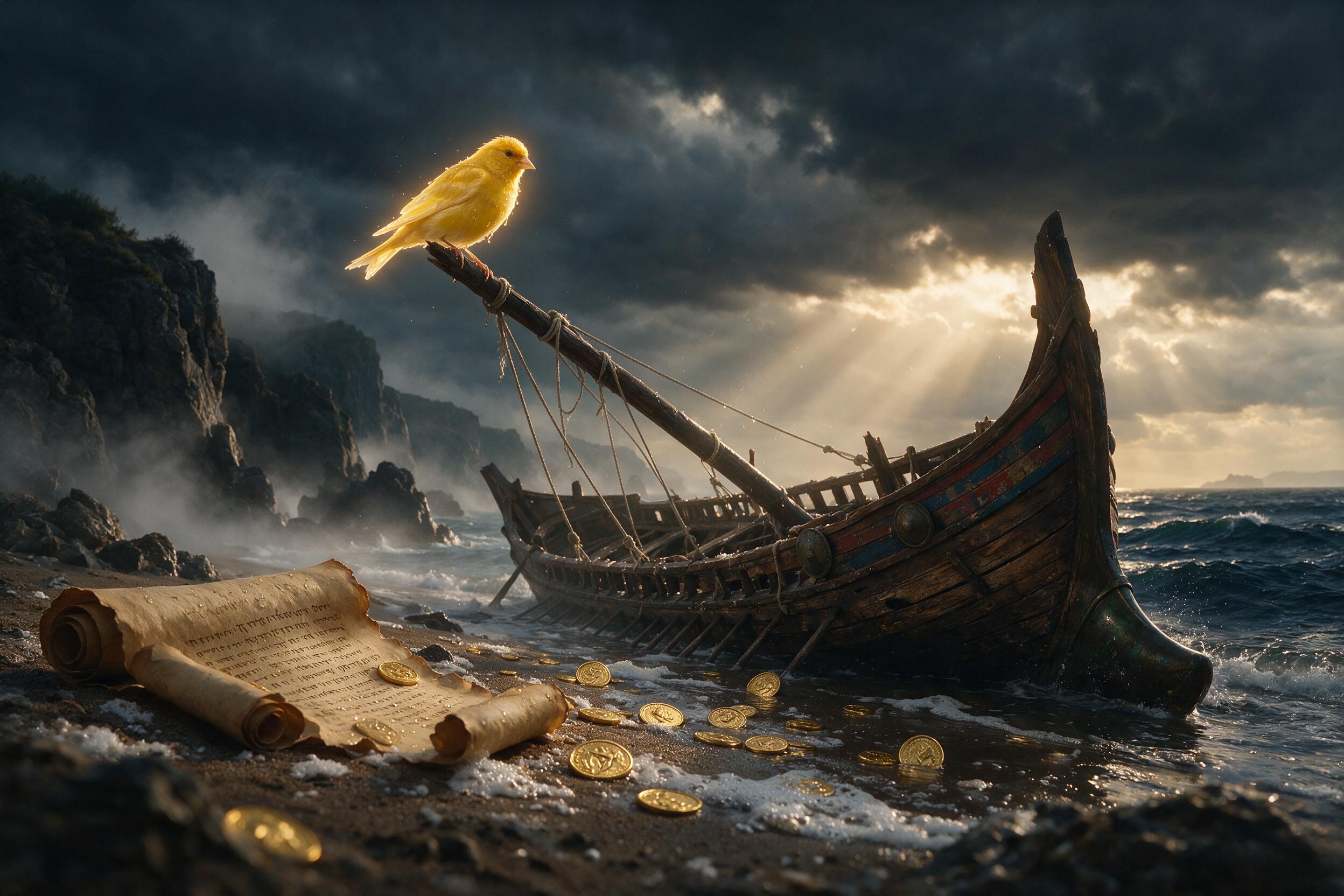
A cinematic lament in the meter of a Homeric voyage, as the ships of Troy turn to ash on the shores of Ithaca.
Fictionalized creative work: This poem and its commentary use mythic imagery to explore the emotional language of crypto borrowing, yield, defaults, and wind-downs. It is not a factual chronology, legal finding, investment analysis, or allegation of misconduct. References should be checked against primary records rather than read as established facts.
Prologue: The Muse Is Asked to Remember the Wreck
Every financial voyage begins with a map. Every myth begins with a voice asking the Muse to tell us what happened. Here, the map is a protocol dashboard, the voice is a mariner who believed the promised return, and the sea is large enough to contain both a smart contract and the things a smart contract cannot do.
Book I: The Architects and the Golden Promise
Tell me, O Muse, of the architects who set sail from the harbor,
bearing chests of minted gold across the boundless, algorithmic deep.
They spoke of uncharted islands—of lenders in the sunlit East,
where uncollateralized trust would outshine the cold iron of banks,
and the song of the Golden Finch promised twenty cubits of grain for ten.
The first spell is architectural. A harbor becomes an ecosystem, a product becomes a vessel, and difficult credit work is translated into a clean horizon. The “twenty for ten” promise is mythic arithmetic, not a quoted return.
Book II: The Sirens of Yield
For many seasons we rowed under fair skies, enchanted by the Sirens of Yield.
“Stake your silver,” the elders chanted at the mast, “bind your fate to the Vault.”
And we poured the lifeblood of our ships into the Senior Pool,
believing the scroll, the oracle, and the promised return across the wine-dark sea.
A pool can be transparent and still be difficult to understand. A ledger may show positions and transactions without answering how a borrower is assessed, how a default is resolved, how quickly an asset can be sold, or what a depositor can recover after the weather changes.
Book III: Scylla, Charybdis, and the Borrowers Who Did Not Return
Then the winds turned foul at the edge of the known world.
The borrowers did not return. The couriers sent to distant shores vanished into dust.
Like Scylla tearing oars from the hull, default seized the forward galleys;
the legal writs were swallowed whole by Charybdis, where paper laws cannot reach.
The poem gives distance, enforcement, timing, information, and the gap between on-chain records and off-chain obligations the bodies of monsters. It asks what “recoverable” means when the asset, borrower, and remedy live in different worlds.
Book IV: Ithaca Without a Triumph
Now the goldfinch has fallen from the rigging, its bright plumage gray.
The sails are cut loose, the great engine put to sleep.
No conqueror enters Ithaca in triumph—only a quiet shore of scattered driftwood,
where weary mariners gather what few coins the tide washed back,
watching the embers of an unbuilt empire sink beneath the waves.
The poem refuses the usual ending. There is only the shore: the place where people sort the remaining coins and decide which parts of the voyage were promises, assumptions, or weather. “The great engine put to sleep” is a poetic image for a wind-down, not a verified announcement.
Coda: What the Tide Leaves Behind
Ambition does not cancel structure. Trust does not cancel underwriting. A token does not cancel liquidity. Before boarding any financial voyage, ask who owns the oars, who reads the map, and what happens when the tide refuses to bring the gold back.
For context only, readers can review the Goldfinch governance forum, protocol documentation, and public Dune dashboard. This creative work does not independently verify or summarize those sources.