Fictional satire & commentary
The GFI Vault Curse: A Fictional Parody About the Goldfinch Wind-Down
A fictional parody inspired by the Goldfinch wind-down, GIP-87, and reported borrower defaults; not a factual account or allegation.
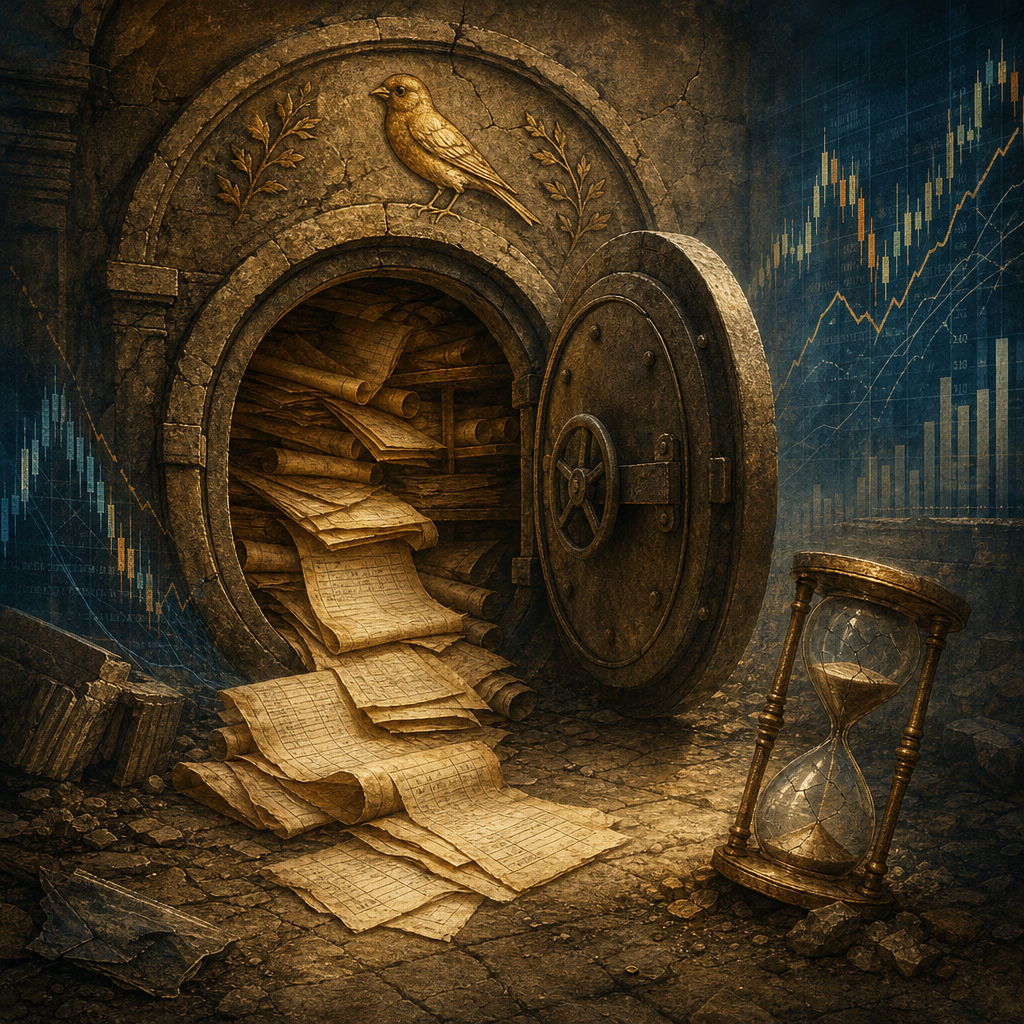
Fictional satire and public-record commentary: The parody framing, dialogue, characters, and jokes below are invented for commentary. They are not a factual account or a finding or allegation of wrongdoing, intent, insolvency, or liability by Goldfinch, Warbler Labs, any named borrower, or any other entity. The opening recap and the linked reporting are sourced separately and should be reviewed in their original context.
What actually happened, before the parody begins
On June 12, 2026, Warbler Labs, the team behind the Goldfinch protocol, posted governance proposal GIP-87, proposing to wind down Goldfinch Prime and move the protocol into "maintenance mode." [gip87] [thedefiant]
The Snapshot vote passed with effectively unanimous support: roughly 1.1 million GFI in favor against a 250,000-token quorum, with no recorded votes against. [thedefiant]
Depositors now face a recovery horizon of two or more years, managed through a new trust set up to collect and distribute remaining loan payments. Reported estimates put real losses around 70%, against a roughly 20% figure shown on the protocol's own dashboard. GFI trades roughly 99.8% below its January 2022 all-time high. [thedefiant]
The wind-down followed a string of defaults among Goldfinch's real-world borrowers, including Tugende (a Kenyan motorbike-finance company), Stratos, and Lend East, tied to tens of millions of dollars in reported losses. [dlnews] [thedefiant]
Below is a fictional parody inspired by those events.
The GFI Vault Curse
A cursed-tomb parody in three acts and one moral, 2026
Act I — The Announcement
In the fictional retelling, the Goldfinch DAO forum does not simply receive a governance post. It receives a sealed scroll, dated June 12, 2026, and titled — in suitably ceremonial language — GIP-87. [gip87]
The scroll is unsealed at a virtual roundtable. A voice, credited only as "the Keeper of the Treasury," reads the inscription aloud: "Begin an orderly wind-down. Halt new development. Enter maintenance mode." [gip87]
A single condition is attached: a $150,000 service fee to formally close the vault. Token holders vote. The result: roughly 1.1 million GFI in favor, none opposed. Even the skeptics in the back row can't find a reason to object. [thedefiant]
The forum falls silent, the way a room falls silent right before someone realizes the treasure chest has been empty for a while.
Act II — The Curse of the Loss-Rate Gap
Every cursed-vault story needs a moment where the heroes realize the map was wrong. Here, it arrives as a dashboard.
The official dashboard shows an estimated 20% loss rate. Depositors comparing notes report something closer to 70%. [thedefiant]
The gap is explained, in the parody, as an ancient curse: gold that looks correct by torchlight but turns to dust the moment it's counted in daylight.
The named culprits are not mummies but borrowers: Tugende, a Kenyan motorbike-finance company; Stratos; and Lend East — three real-world lending relationships that soured into defaults linked to tens of millions of dollars in reported losses. [dlnews] [thedefiant]
Meanwhile, GFI performs its own disappearing act, down roughly 99.8% from its January 2022 all-time high — a vertical drop that would make any cursed-tomb legend proud. [thedefiant]
Act III — Welcome to Maintenance Mode
With the vault resealed, a new role is created: the Keeper of Repayments, a trust tasked with collecting whatever remains and distributing it to whoever is still holding a claim ticket. [gip87]
"We will collect. We will distribute. Please allow two or more years for processing." — The Keeper of Repayments [thedefiant]
The legacy interface — the dApp, in non-parody language — stays open to visitors, a little like a gift shop attached to a tomb that's still technically being excavated. It's expected to remain live for at least six months after the final loan repayment arrives, whenever that turns out to be. [thedefiant]
A lone token holder asks the question every cursed-vault story eventually asks: "When do we get out of here?" The Keeper's answer is the same one real wind-downs give: "When the recoveries are orderly."
Final Scene — The Moral of the Crypt
Cursed-tomb franchises reliably return for another installment on a release schedule fans can circle on a calendar. Goldfinch depositors were promised a return too — just measured in quarterly trust updates instead of trailers, and without the popcorn.
The real lesson, once the parody wig comes off, isn't about curses at all. It's the lesson every real-world-asset lending protocol eventually runs into: moving capital onto a blockchain makes it faster to move, not easier to underwrite. The collateral, the borrowers, and the legal enforcement all still live in the offline world, curse or no curse. [dlnews]
The vault door closes. The trust keeps the lights on. And somewhere, a spreadsheet marked "Recoveries — do not open until 2028" waits quietly in a folder, exactly like something sealed in a tomb.
The pain, translated
- 70% real loss rate vs. 20% on the dashboard becomes: the map said "X marks the spot," and the spot had already been excavated. [thedefiant]
- A $150,000 wind-down service fee becomes: even closing a vault costs an admission fee. [thedefiant]
- A two-or-more-year recovery horizon becomes: the treasure is real, technically, and will be mailed to you sometime after the sequel comes out. [thedefiant]
- A 99.8% decline from the all-time high becomes: the gold was there once. There is a very detailed chart proving it. [thedefiant]