Fictional satire · transparency & accountability
You Can See Everything Except Your Money
A fictional mock-documentary about transparent finance and opaque reassurance.
By Editorial Desk · October 22, 2026 · 10 min read
Key findings
Fictional satire: these points describe the article’s themes and imagined scenes, not actual statements, verified events, or findings of wrongdoing.
- Invented mock-documentary scenes question whether visible transactions and governance information provide economic clarity or repayment.
- GFI token ownership, legacy lending exposure and Goldfinch Prime redemption are different experiences; the satire explicitly rejects a claim that everyone lost everything.
- Exchange listings and venture backing are distinct roles, not repayment guarantees; the $150,000 proposal is a services budget, not a compensation fund.
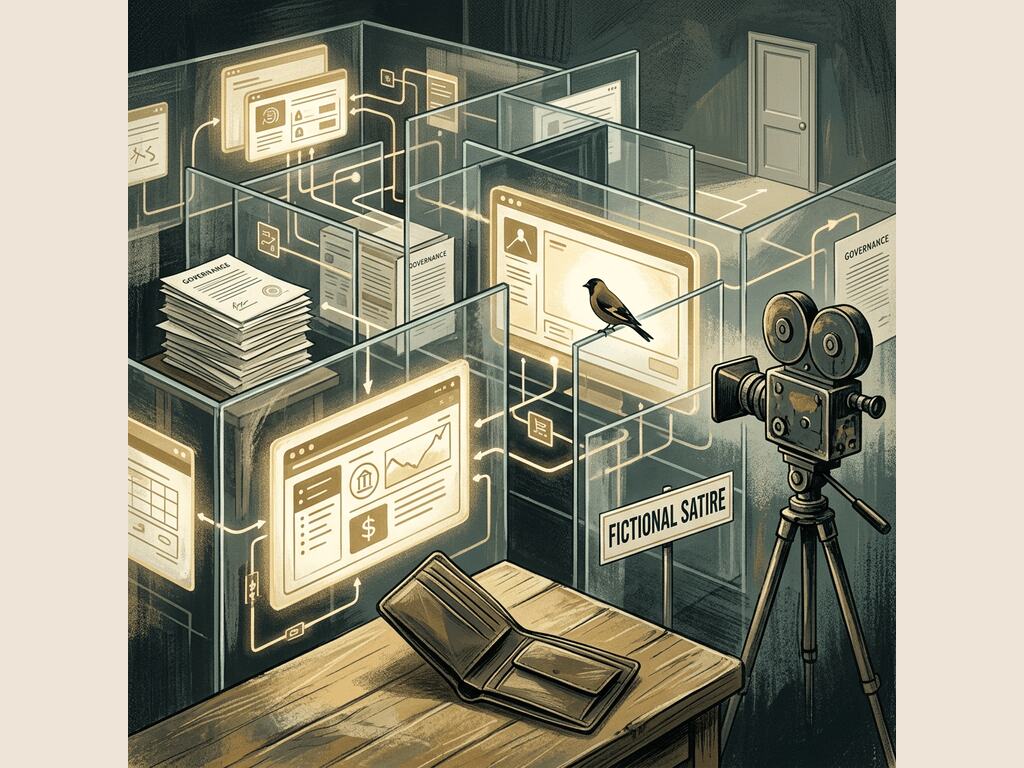
Fictional satire with sourced background. All mock-documentary dialogue, characters and scenes are invented. Film discussion draws on published descriptions and reviews, not a personal viewing. This is not affiliated with the film or the named companies, does not equate Goldfinch with Theranos, and does not establish fraud or a reimbursement obligation.
The movie: plot and what it is really examining
Spoilers follow. This analysis draws on published reviews and plot descriptions, not a personal viewing.
Plot
You Can See Everything, directed by Nathan Fielder and Lance Oppenheim, begins 34 days before Elizabeth Holmes reports to prison. Holmes and her partner, Billy Evans, invite filmmakers into their Southern California home, apparently offering extraordinary access to their private lives. What begins as a portrait of Holmes before incarceration becomes a much larger examination of her explanations, Evans’s ambitions, and the filmmakers’ ability to establish what is true. BAM
Fielder repeatedly probes the gap between what Holmes says she intended and what investors understood. The exchanges become so circular that he introduces Abbott and Costello’s “Who’s on First?” as a communication analogy. The documentary then extends beyond Holmes’s imprisonment into Evans’s efforts around a new blood-testing venture, with reconstructions helping depict events the cameras did not capture. RogerEbert.com
Review synthesis
The film’s most interesting question is not simply “Was Theranos fraudulent?” It is: “What does access actually prove?” Cameras may record a person extensively without resolving whether that person is being candid, performing sincerity, or constructing a narrative. RogerEbert.com’s review praises the film for interrogating both its subjects and the documentary process itself. RogerEbert.com
Its comic engine is the mismatch between an ordinary question and an extraordinarily elaborate answer. Its disturbing element is that proximity does not necessarily produce clarity. Reviews emphasize the uncomfortable conversations, claustrophobic close-ups, and uncertainty about how much the filmmakers—and therefore the audience—can genuinely know. RogerEbert.com
That is the useful connection for this parody: not “Goldfinch equals Theranos,” but “visibility, prestigious affiliations, and abundant explanations are not the same thing as an understandable investment outcome.”
The factual foundation: distinguish the investments
The parody needs one important distinction to avoid misrepresenting customer losses: Goldfinch Prime, legacy lending positions, and GFI tokens are not interchangeable.
| Entity or investment | Relevant documented role or outcome |
|---|---|
| Coinbase | Announced GFI trading support on Coinbase Pro. Its announcement describes GFI as a governance token, not an insured deposit or guaranteed-return product. Coinbase |
| Coinbase Ventures | Lists Goldfinch in its portfolio. That investment relationship is distinct from Coinbase’s exchange-listing role. Coinbase Ventures |
| GFI | Governs the Goldfinch protocol. In the wind-down discussion, a co-founder said GFI would continue to exist because its smart contract is immutable; continued existence does not promise economic recovery. Coinbase · Goldfinch governance discussion |
| Goldfinch legacy lending positions | The wind-down proposal describes serious borrower-performance problems and continuing recovery efforts. The July update says these positions were still awaiting payments or in recovery. Goldfinch governance discussion |
| Goldfinch Prime | A July 7, 2026, forum update reports full redemption of investors’ token value, plus an additional month of interest. It explicitly says this did not apply to legacy V1 deals. Goldfinch governance discussion |
| Warbler Labs | The wind-down proposal specifies a fixed $150,000 USDC services payment for transition, wind-down, and maintenance work over two or more years. That is an operating-services budget, not a customer compensation fund. Goldfinch governance discussion |
Reporting in June described GFI as approximately 99.8% below its January 2022 high. That is a historical peak-to-price comparison—not a statement that every investor lost that percentage, and not a measure of legacy lenders’ eventual recovery. The Defiant
The evidence supports criticism of investment outcomes, communication, and the gap between perceived backing and actual protection. It does not, by itself, establish fraud, coordinated dumping, or a legal obligation for Coinbase to reimburse Goldfinch investors.
Original parody: “You Can See Everything Except Your Money”
A fictional mock-documentary about transparent finance and opaque reassurance.
All dialogue, characters, scenes, and comic situations below are invented. The corporate names refer to real entities, but the scenes do not depict actual meetings or statements. The parody does not equate investment losses with criminal fraud.
Cold open: the dashboard
A camera studies a laptop.
On-screen:
PORTFOLIO STATUS: VISIBLE
WITHDRAWABLE BALANCE: A MORE COMPLEX QUESTION
An investor, Arun, refreshes the page.
DOCUMENTARIAN: What are you trying to do?
ARUN: Withdraw my money.
DOCUMENTARIAN: And what happens?
ARUN: I learn more about the ecosystem.
He clicks again.
A governance proposal opens.
ARUN: Every time I look for the exit, I receive more reading.
Title card:
YOU CAN SEE EVERYTHING EXCEPT YOUR MONEY
Scene 1: the credibility room
A fictional investment presentation occupies a pristine conference room.
On one wall: a Coinbase Ventures logo.
On the opposite wall: a large disclaimer.
Arun stands between them.
ARUN: I saw the Coinbase Ventures connection. Then I saw GFI on Coinbase. I thought those things meant something together.
FICTIONAL EXCHANGE REPRESENTATIVE: They mean two separate things.
ARUN: But they appeared together in my confidence.
REPRESENTATIVE: Your confidence was not a joint venture.
The documentarian measures the distance between the logo and the disclaimer.
DOCUMENTARIAN: The logo can be understood from across the room. The disclaimer requires you to approach it.
The camera approaches.
Then approaches again.
Scene 2: what exactly did you buy?
Three chairs face the camera.
Their labels read:
GFI TOKEN HOLDER
LEGACY LENDER
GOLDFINCH PRIME INVESTOR
DOCUMENTARIAN: To avoid confusion, we invited three different investment experiences.
PRIME INVESTOR: I received my redemption.
LEGACY LENDER: I’m still dealing with recovery uncertainty.
GFI HOLDER: My token still exists.
A long silence.
DOCUMENTARIAN: Is existence the same as value?
GFI HOLDER: Not in my experience.
An editor enters carrying a dramatic title card:
EVERYONE LOST EVERYTHING
DOCUMENTARIAN: We can’t use that. It isn’t accurate.
EDITOR: What can we use?
The documentarian writes:
DIFFERENT PEOPLE HAVE DIFFERENT CLAIMS, OUTCOMES, AND LEVELS OF ANGER
EDITOR: That won’t fit on a thumbnail.
Scene 3: the governance experience
Arun opens a governance page.
ARUN: I wanted to know who was responsible.
FICTIONAL GOVERNANCE FACILITATOR: Have you participated in governance?
ARUN: I bought a token.
FACILITATOR: Excellent. You have a voice.
ARUN: Can my voice redeem my principal?
FACILITATOR: Your voice can comment on the proposal concerning the process supporting potential recovery of applicable principal.
Arun looks at the camera.
ARUN: Before crypto, I thought a bank putting me on hold was frustrating.
A notification appears.
YOUR COMMENT HAS RECEIVED ONE LIKE
ARUN: Is that liquid?
Scene 4: the wind-down presentation
A fictional Warbler Labs services presenter stands beside a slide:
MAINTENANCE MODE
Less future. Continued infrastructure.
PRESENTER: We are preserving access.
ARUN: Access to what?
PRESENTER: The application.
ARUN: And the money?
PRESENTER: Any available repayments.
ARUN: Those are two very different things.
PRESENTER: Which is why we have separate sections.
The next slide displays the proposed $150,000 services budget.
DOCUMENTARIAN: What does that pay for?
PRESENTER: Wind-down support, transition work, and maintenance.
ARUN: So there is a budget for keeping the recovery process running.
PRESENTER: Yes.
ARUN: I wish my household expenses would accept a recovery process.
The camera remains on an ordinary hosting invoice.
No ominous music plays.
DOCUMENTARIAN, VOICE-OVER: Keeping software online costs money. That was true. It was also not the question Arun had hoped to answer.
Scene 5: the responsibility diagram
The documentarian constructs a physical model.
Coinbase is a storefront.
Coinbase Ventures is a separate office.
Warbler Labs is a workshop.
Goldfinch is a lending platform.
GFI is a small voting booth.
The borrower is at the far end of the room, behind a door marked:
REAL WORLD
ARUN: Where is the repayment?
DOCUMENTARIAN: That is what we are trying to locate.
Arun follows a string from his investment through the model.
It ends at the borrower’s door.
He knocks.
No answer.
Behind him, every computer remains operational.
ARUN: So the system can function while my investment doesn’t.
DOCUMENTARIAN: That appears to be the distinction.
Scene 6: the immutable ending
The camera returns to the GFI holder.
DOCUMENTARIAN: What did you understand “immutable” to mean?
GFI HOLDER: Something that couldn’t disappear.
DOCUMENTARIAN: And now?
GFI HOLDER: I understand that something can remain present without becoming useful to me.
His wallet still displays the token.
He closes the laptop.
It makes a reassuring sound.
Final scene: the kitchen table
No logos. No price chart. No presentation.
Arun sits with a household budget.
ARUN: I can accept that investments have risk.
DOCUMENTARIAN: Then what bothers you?
ARUN: How easy it was to combine the names into reassurance—and how hard it became to separate them when I wanted answers.
The camera pulls back.
On the laptop:
RECOVERY UPDATE
Arun opens it.
He begins reading.
Cut to black.
The transactions were visible.
The affiliations were visible.
The proposal was visible.
None of those, by themselves, was a repayment.
Why this version works
The sharpest target is the gap between technical transparency and economic clarity—not an unsupported allegation of a conspiracy.
The movie’s access-versus-understanding tension provides the structure. The documented Goldfinch distinctions provide the substance: an exchange listing, a venture investment, governance-token ownership, legacy lending exposure, and Prime redemption each mean something different. The satire comes from an investor discovering those differences only when they become financially consequential. RogerEbert.com