Fictional satire · payments & private-credit risk
The Bank-Grade Buzzword Laundromat
A fictional pitch meeting separates bank-grade payments from crypto lending risk.
Key findings
Fictional satire: these points describe the article’s themes and imagined scenes, not actual statements, verified events, or findings of wrongdoing.
- The fictional pitch meeting questions whether bank-grade payment language improperly reassures readers about unrelated lending risks.
- The commentary distinguishes ecosystem connections from proof of a formal partnership, endorsement, or product integration.
- Its parody separates regulated payment infrastructure from borrower creditworthiness, liquidity, and the rights attached to an investment.
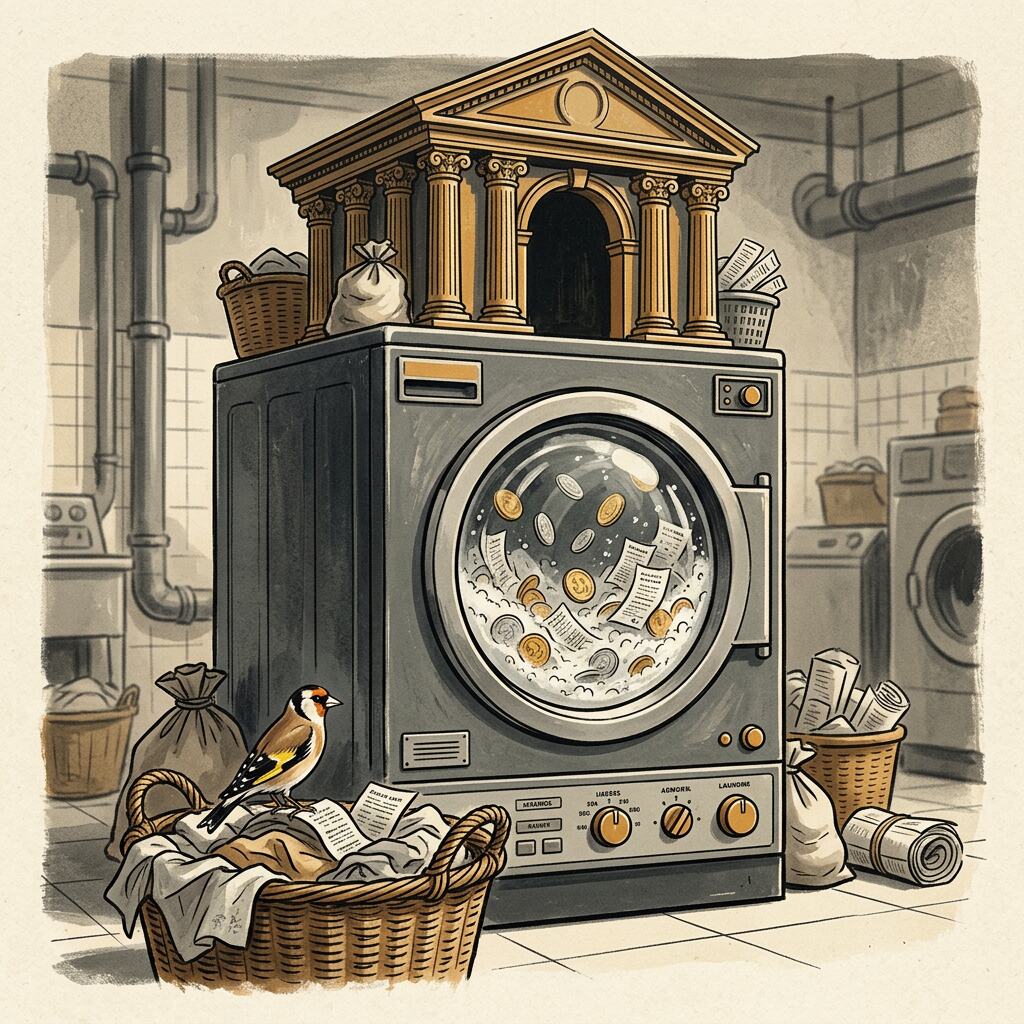
Fictional satire. The Citi–Coinbase payments initiative is real; the dialogue and “marketing plan” below are fictional. Nothing here establishes that Coinbase intends to deceive customers.
Satire. The Citi–Coinbase payments initiative is real; the dialogue and “marketing plan” below are fictional. Nothing here establishes that Coinbase intends to deceive customers.
Coinbase has found a remarkable way to make crypto sound reassuring: put the words “bank-grade” in front of it and hope nobody asks which risks the bank is actually taking.
In the announced arrangement, Citi would provide virtual-account banking infrastructure for Coinbase business customers, while Coinbase would handle digital assets and potential conversions between fiat and USDC. Citi’s corporate clients could also accept stablecoin payments without holding stablecoins themselves. That is a payments product—not a promise that every crypto asset, loan, or token available elsewhere in the ecosystem has become bank-safe. finance.yahoo
The fictional pitch meeting writes itself:
“The customer wants to know whether it’s safe.”
“Tell them a bank is involved.”
“In which part?”
“Please don’t make the font that small.”
Enter the goldfinch
Consider a different Coinbase-adjacent history. Former Coinbase employees Mike Sall and Blake West founded Goldfinch, whose developer, Warbler Labs, helped build a protocol for making real-world loans through crypto. Goldfinch’s GFI governance token later became available on Coinbase. Those connections are real; they do not make Goldfinch a Coinbase product or Citi a participant in its loans. coinmarketcap
Goldfinch offered an excellent lesson in the distance between an elegant interface and an enforceable loan. In 2023, its community reported trouble with the Tugende Kenya facility. In 2024, Warbler Labs reported that borrower Lend East expected to repay only about $4.25 million of a $10.15 million Goldfinch pool. Warbler Labs also said it would backstop specified losses involving a separate Stratos pool—a detail worth retaining, even in a roast. gov.goldfinch
By June 2026, Sall and West proposed moving Goldfinch into maintenance mode and winding down Goldfinch Prime, citing serious performance issues in some borrower pools and the need to pursue recoveries. Their proposal said the original protocol had enabled approximately $100 million in loans. That is a sobering history, not proof of a plot to fool anyone. gov.goldfinch
The trick satire is mocking
The imaginary trick is association: let “Citi” imply safety, let “Coinbase” imply vetting, let “onchain” imply transparency, and let the customer supply the missing conclusion. But a bank handling payment accounts does not underwrite an unrelated lending protocol. An exchange listing a governance token does not guarantee the loans behind that protocol. And seeing a transaction on a blockchain does not make a struggling borrower repay it. Goldfinch’s own recovery-focused proposal makes that last distinction painfully concrete. finance.yahoo
So here is the honest version of the advertisement:
Now with bank-grade payments. Please evaluate token prices, lending exposure, borrower credit, and who owes you what separately.
It is less catchy. It might also be the first crypto slogan that survives the fine print.