Fictional parody · governance, disclosure & registration
Registering a Major Convenience
Governance, economic freedom and the reassuring weight of a very clearly labeled PDF.
Key findings
Fictional satire: these points describe the article’s themes and imagined scenes, not actual statements, verified events, or findings of wrongdoing.
- The imagined registration narrative parodies attempts to resolve difficult token questions through convenient labels and disclosure rhetoric.
- Fictional paperwork and exaggerated explanations mock the idea that more documentation automatically makes economic risks understandable.
- The parody contrasts the appearance of regulatory progress with substantive questions about investor expectations, governance, and transparency.
Clearly fictional satire inspired by Coinbase’s February 21, 2025 post, not a Coinbase publication. The first-person corporate voice, registration announcement, disclosure assurances, PDF descriptions and governance scenarios are invented, not actual company quotations or policies. Nothing here asserts that GFI or another token is registered as a security, that Coinbase adopted this fictional standard, or that Coinbase, Goldfinch, Coinbase Ventures or any other entity committed wrongdoing. Token classification depends on specific facts, transactions, jurisdiction and applicable law. The referenced blog expressed Coinbase’s position on an agreement in principle, subject to Commissioner approval; it is not a universal merits ruling. No affiliation or endorsement is asserted. Not investment, legal or regulatory advice.
Below is a satirical parody modeled on the triumphant, “we were right all along” tone of Coinbase’s Righting a major wrong post. The original argues that the SEC’s contemplated dismissal would vindicate Coinbase and calls for durable legal clarity for crypto; this parody flips that rhetoric to mock selective enthusiasm for disclosure and securities registration. coinbase
Parody: “Registering a major convenience”
Satire. This is fictional commentary, not an allegation of wrongdoing by Coinbase, Goldfinch, Coinbase Ventures, or any other person or entity. It is not investment, legal, or regulatory advice.
Today, we are proud to announce a historic achievement for onchain freedom:
We have discovered that selling governance tokens with absolutely no red flags is much easier when everyone agrees to call them registered securities.
For too long, builders have faced an impossible choice: innovate freely, distribute tokens broadly, describe them as decentralized governance instruments, and then endure the burdensome question of whether buyers might reasonably expect profits from somebody else’s efforts.
No more.
Welcome to the future of compliant decentralization:
- Tokens carefully engineered for community empowerment
- Governance rights that are meaningful, spiritually meaningful, and potentially economically meaningful
- Investor materials that are not “marketing,” except in the broad cultural sense
- Transparent disclosures located wherever legally required, conveniently after the exciting part
- No red flags—only immaculately formatted risk factors
We have always believed that a token may represent governance, utility, participation, alignment, contribution, protocol stewardship, community coordination, and—where appropriate—a security sold under a registration statement containing several hundred pages of disclosures explaining why none of those words should be construed too enthusiastically.
That is not a contradiction. That is regulatory clarity.
The innovation
Consider the modern governance-token experience:
You purchase a token.
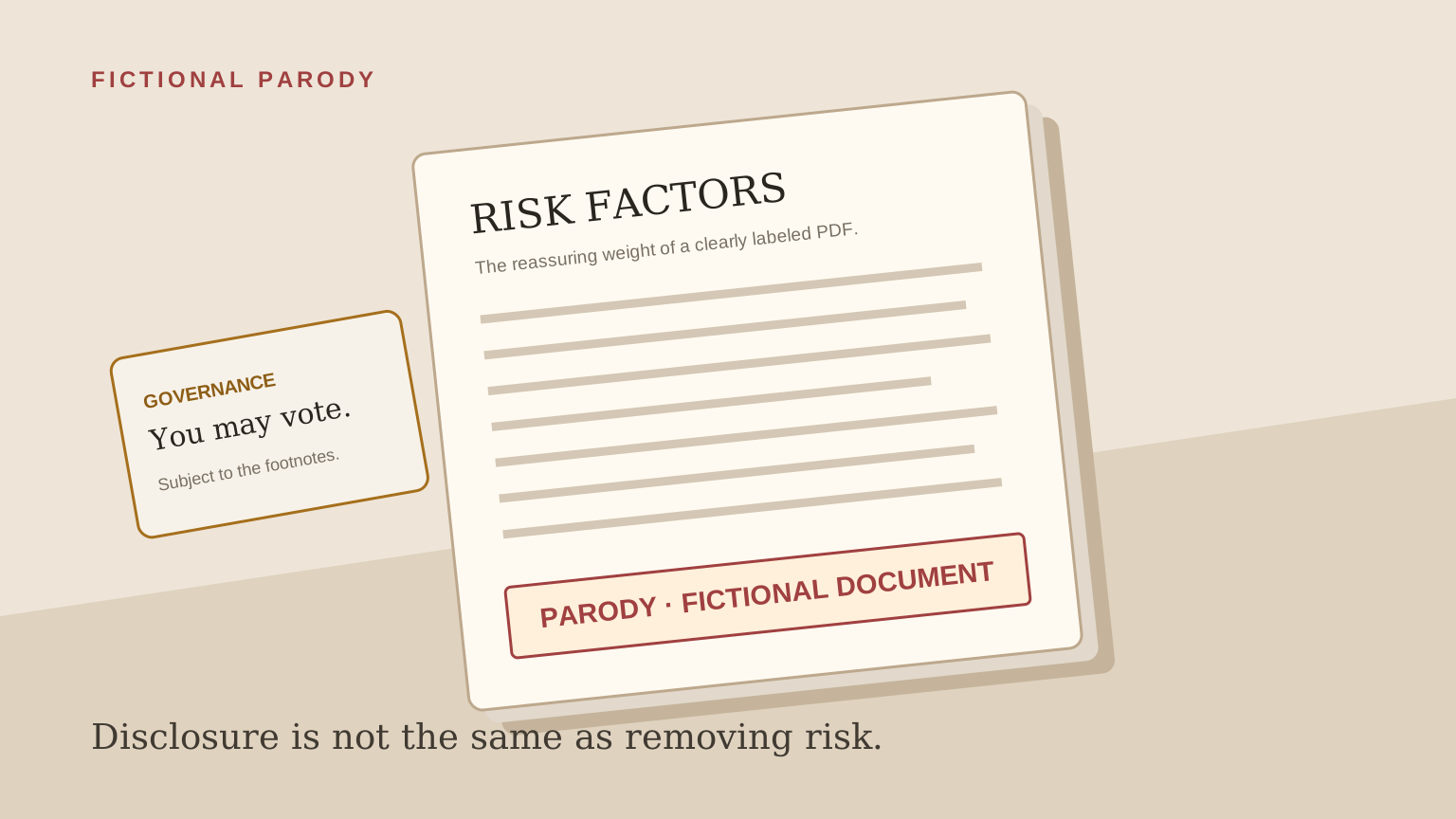
You may vote.
Your vote may influence a protocol.
The protocol may generate revenue.
The token may appreciate.
Or decline.
Or become illiquid.
Or be subject to token-holder proposals, delegate concentration, smart-contract vulnerabilities, market volatility, enforcement uncertainty, lockups, vesting, offshore restrictions, or the time-honored governance process of “a Discord poll at 2:13 a.m.”
But rest assured: every potential risk will be fully disclosed in a document so comprehensive that no reasonable person could possibly finish reading it before the market moves.
This is how we protect customers: not by removing risk, but by placing risk in a clearly labeled PDF.
A new standard
At Coinbase, we believe the future belongs to tokens that can be simultaneously:
- Community-led, subject to the usual arrangements involving founders, large holders, delegates, service providers, investors, foundations, and entities with operational responsibilities
- Decentralized, subject to governance quorums and a modest concentration of voting power
- Utility-bearing, subject to the possibility that the relevant utility will arrive later
- Tradable, subject to availability, liquidity, eligibility, market conditions, and platform discretion
- Properly registered, subject to the exhilarating possibility that everyone finally receives the disclosures they claimed to want
This is a win for token holders, builders, securities lawyers, disclosure specialists, risk-factor enthusiasts, and anyone who has ever asked, “What exactly am I buying?”
On Goldfinch and governance
Governance tokens such as GFI can be framed as mechanisms for participation in decentralized protocol governance. Whether a particular token is offered, sold, or traded as a security depends on its specific facts, transaction structure, disclosures, jurisdiction, and applicable law—not on a press release, a listing, a venture investment, or a meme.
Which is why our fictional new standard is simple:
If it walks like a governance token, talks like a governance token, and someone expects it to rise in value, do not panic. Add more footnotes.
Disclosure is the ultimate decentralization primitive.
The path forward
America must choose: will it lead the world in transparent, compliant, carefully disclosed tokenized finance—or will it leave innovation to jurisdictions where the risk factors are only 14 pages long?
We believe in a future where every investor can confidently say:
“I understood the risks. At least, I acknowledge that I received the risk factors.”
That is economic freedom.
That is consumer protection.
That is governance.
And that is why we will never stop building, listing, disclosing, risk-factorizing, and—when necessary—registering the future onchain.
Forward-looking statement: The foregoing is satire. Any resemblance to an actual token launch, securities offering, governance framework, legal position, regulator, exchange, venture investor, or “no red flags” assurance is entirely intentional as parody, but should not be taken as a factual assertion about any real entity.
Source and editorial context
- Coinbase, “Righting a major wrong,” by Paul Grewal, February 21, 2025: the source post described SEC staff agreeing in principle to dismiss its enforcement case against Coinbase, subject to Commissioner approval. Its characterization of the case and the significance of dismissal is Coinbase’s stated position.
- The source supplies the rhetorical model for this parody—not evidence that GFI or any governance token was registered, that Coinbase adopted the fictional policy, or that a dismissal determined the merits of every token-related legal question. The first-person corporate voice, registration announcement, risk-factor assurances, PDF descriptions and governance scenarios above are invented.
- This independent parody is not a Coinbase publication, company statement, customer record, securities filing, regulatory decision, or allegation of wrongdoing. No affiliation or endorsement by Coinbase, Goldfinch or Coinbase Ventures is asserted.