Fictional satire · trading volume & incentives
The Golden Flush
An imaginary toilet asks whether trading volume creates value—or just another fee.
Key findings
Fictional satire: these points describe the article’s themes and imagined scenes, not actual statements, verified events, or findings of wrongdoing.
- The fictional flushing metaphor questions whether trading activity benefits users or mainly generates fees.
- Invented dialogue about a signup agreement contrasts accepting total-loss risk with receiving useful value; it is not a quotation from an actual agreement.
- The lesson asks who supplies funds, controls the platform, collects fees, and retains value when trading stops.
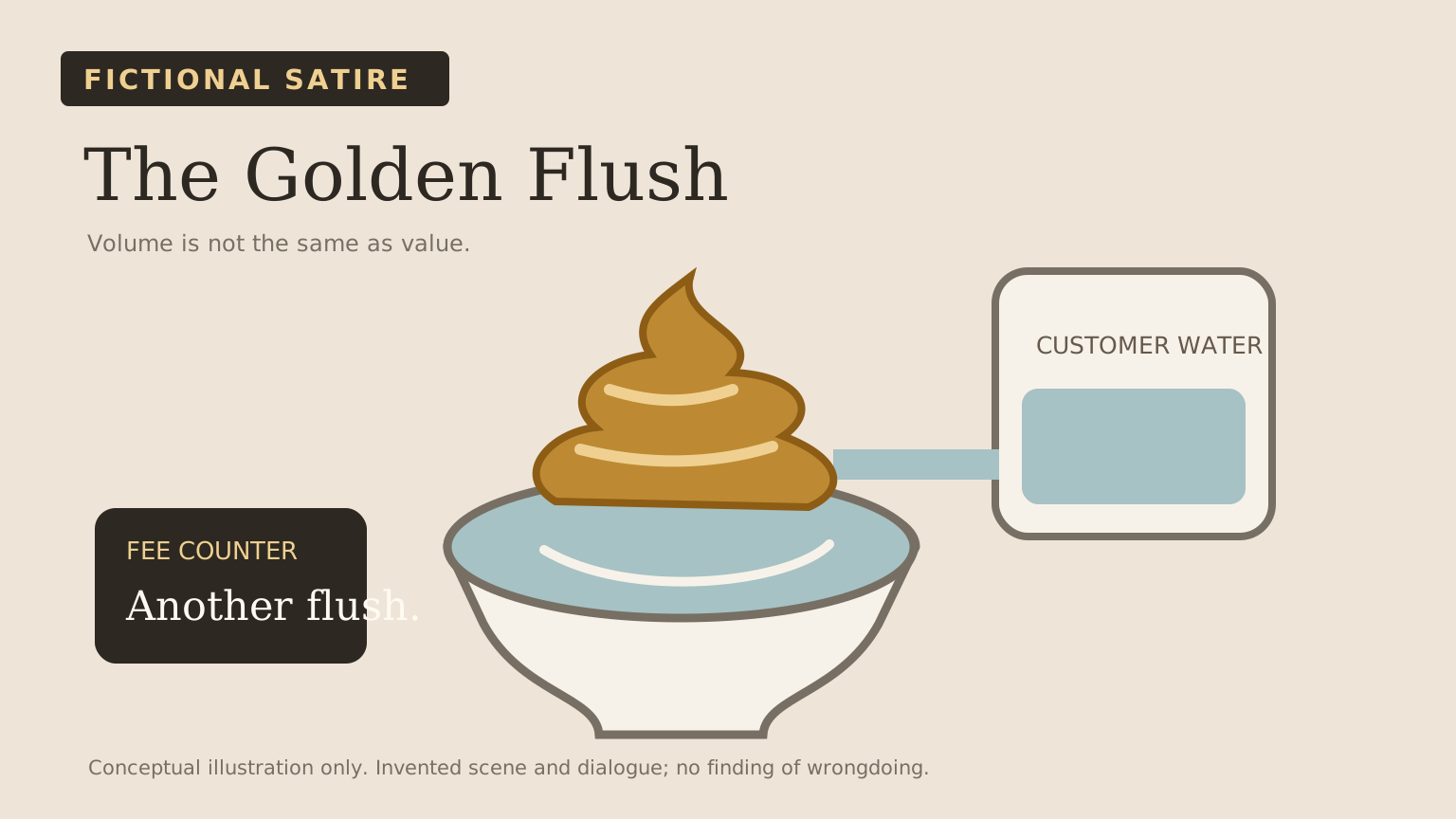
Fictional satire. “Golden Poop,” the toilet, and every attributed exchange of dialogue are invented metaphors, not actual statements, products or events involving Coinbase, Coinbase Ventures or a16z. This piece questions trading incentives; it does not establish wrongdoing, coordinated conduct or the creation or sale of a particular token by any named party. USDC is used as a metaphor for customer funds, not as an allegation about its issuer. No affiliation or endorsement is asserted.
A fictional satire—not an account of actual events.
Coinbase Ventures and a16z looked at crypto and said:
“Let’s make Golden Poop.”
So they did.
It was shiny, scarce, expensive, and accompanied by a very long explanation of why it was definitely not poop.
Then Coinbase built a toilet.
Customers arrived with USDC.
“What’s the USDC for?”
“Water,” Coinbase said.
“What does the water do?”
“It flushes the Golden Poop.”
Customers poured in their USDC. Coinbase pulled the lever. The Golden Poop spun around the bowl.
Everyone called it liquidity.
Then Coinbase charged a fee.
“For what?” the customers asked.
“The flush.”
“But we supplied the water.”
“Correct.”
“And you own the toilet?”
“Correct.”
“So what do we get?”
“Exposure to Golden Poop.”
Every flush generated trading volume. Every trade generated another fee.
The dashboard lit up. The charts climbed.
“Adoption,” everyone said.
One customer watched the bowl.
“Has anything useful happened?”
“Look at the volume.”
“That’s not what I asked.”
“Look how fast it’s spinning.”
Then the Golden Poop lost its shine.
“What happened to our money?”
“Please read the agreement you accepted when you signed up.”
“Which part?”
“The part warning that crypto assets can lose all their value.”
“So we supplied the water, you collected the fees, and we accepted the risk?”
“You accepted the agreement.”
“We asked what value you created.”
“We answered which box you checked.”
The Lesson
Activity is not the same as value. A fee proves someone got paid—not that something useful was created.
A warning that an asset can lose all its value is not an explanation of what value it creates. Accepting risk and receiving value are two different questions.
Before pouring your USDC into the bowl, ask:
- Who supplied the water?
- Who controls the lever?
- Who collects the fees?
- What do you actually own?
- What value remains when the flushing stops?
And if the answer is “another flush,” you may be the business model—not the customer.