Digital assets & regulation
Coinbase, Goldfinch, and the Governance-Token Question
Why the economic reality behind a token may matter more than the governance-token label attached to it.
Key findings
Summary of this article’s analysis and cited records, not a legal finding or investment advice. Historical details reflect the sources reviewed below.
- Calling an asset a governance token does not, by itself, settle whether a particular offer is an investment contract.
- The article applies Howey-related questions about purchaser expectations and reliance on essential managerial efforts to GFI’s economic reality.
- An exchange listing is not an independent regulatory or judicial determination of a token’s legal status.

Calling a cryptoasset a “governance token” does not, by itself, settle whether it is a security. The more important question is economic reality: when people bought the token, were they investing in a venture whose prospects depended mainly on a centralized team’s work?
That question is worth asking about GFI, the token associated with Goldfinch, particularly given the roles of Coinbase, Warbler Labs, and Goldfinch Prime.
Scope of this article: This is independent commentary and analysis, not a legal conclusion. It does not assert that any entity committed wrongdoing. Statements about events and relationships should be assessed against the underlying public record.
The Goldfinch ecosystem
Goldfinch was presented as an onchain credit protocol. GFI holders had governance-related rights, but the economic story also involved credit operations, borrower and default risk, liquidity, product development, infrastructure, recoveries, and market demand.
Warbler Labs is described in public material as an initial developer of the protocol and interface. Governance activity and other public materials have associated Warbler Labs with core operational decisions, responses to defaults, liquidity or treasury questions, product development, and the Goldfinch Prime wind-down.
Goldfinch Prime was aimed at offering non-U.S. investors exposure to institutional private-credit funds through an onchain structure. Public materials say Goldfinch Prime is being wound down and that new deposits are no longer being accepted.
Why the Howey test matters
“The Howey test generally considers whether there was an investment of money, in a common enterprise, with a reasonable expectation of profits derived from the entrepreneurial or managerial efforts of others.”
The test comes from SEC v. W.J. Howey Co. Applying it to a digital asset is fact-specific; the label used by a project or exchange is only one part of the analysis.
Investment of money
Common enterprise
Expectation of profits
Reliance on the efforts of others
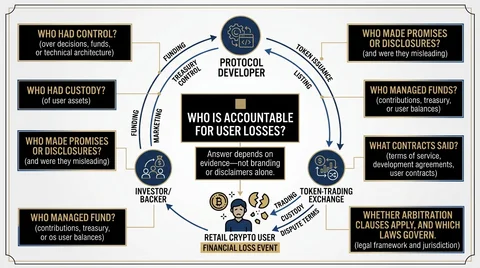
The key issue is not the token’s branding, but whether purchasers reasonably depended on essential managerial work by others.
The centralization issue
The core inquiry is whether Warbler Labs’ work was essential, not merely whether it did work. Relevant areas for examination may include:
- Protocol and interface development
- Technical roadmap and maintenance
- Credit-product design and operations
- Default recovery and loss mitigation
- Treasury, incentives, and liquidity matters
- Strategic partnerships and commercial execution
- Product continuation, pause, or wind-down decisions
- Governance influence and token concentration
That does not prove GFI was a security. But it creates a credible basis for asking whether GFI purchasers relied on Warbler Labs in the way investors rely on a sponsor, management team, or promoter.
Coinbase’s role
Coinbase’s role was as a marketplace where customers could acquire and trade GFI, rather than as the creator of Goldfinch or Warbler Labs. A rigorous listing review would examine the asset and surrounding facts, not treat a listing as a conclusion about legal status.
What should a rigorous listing review examine?
- Purchasers’ profit expectations
- Actual operational control by Warbler Labs
- Governance rights versus practical decision-making authority
- Token allocations, vesting, treasury activity, liquidity, and market making
- Private-credit and default risks
- Potential affiliate investment relationships and conflict controls
A governance token can still be an investment contract
Tokenholder voting is not necessarily the same as operational independence. Where a core company controls the technical roadmap, staffing, credit operations, institutional relationships, product execution, key information, and crisis response, purchasers may still be relying predominantly on that company’s efforts.
The bottom line
The argument is not that every governance token is automatically a security, nor that every GFI transaction necessarily satisfies Howey. The question is whether the economic reality shows that GFI purchasers were relying on essential managerial efforts by Warbler Labs to create or sustain value.
If the evidence showed that purchasers reasonably expected profits from those essential efforts, then the governance-token label would not control the analysis.
Methodology & Legal Disclaimer
This article is independent commentary based on publicly available information and is not an allegation of proven wrongdoing. It does not constitute legal, investment, tax, or regulatory advice. Any legal determination regarding a token depends on specific facts, transaction context, applicable law, and adjudication by a court or regulator.