Fictional satire · venture branding & token speculation
The Coinbase Ventures Derby
In the race for the next crypto winner, some bettors mistake an investor logo for a finish line.
Key findings
Fictional satire: these points describe the article’s themes and imagined scenes, not actual statements, verified events, or findings of wrongdoing.
- An imaginary venture derby parodies investors treating familiar backing logos as substitutes for project-level due diligence.
- An invented pre-race shutdown leaves imaginary token buyers with a zero-value souvenir; this is not a finding that Coinbase Ventures caused real closures or that every affected token is worth zero.
- The parody asks readers to examine token economics and operations instead of mistaking a funding announcement for a guarantee.
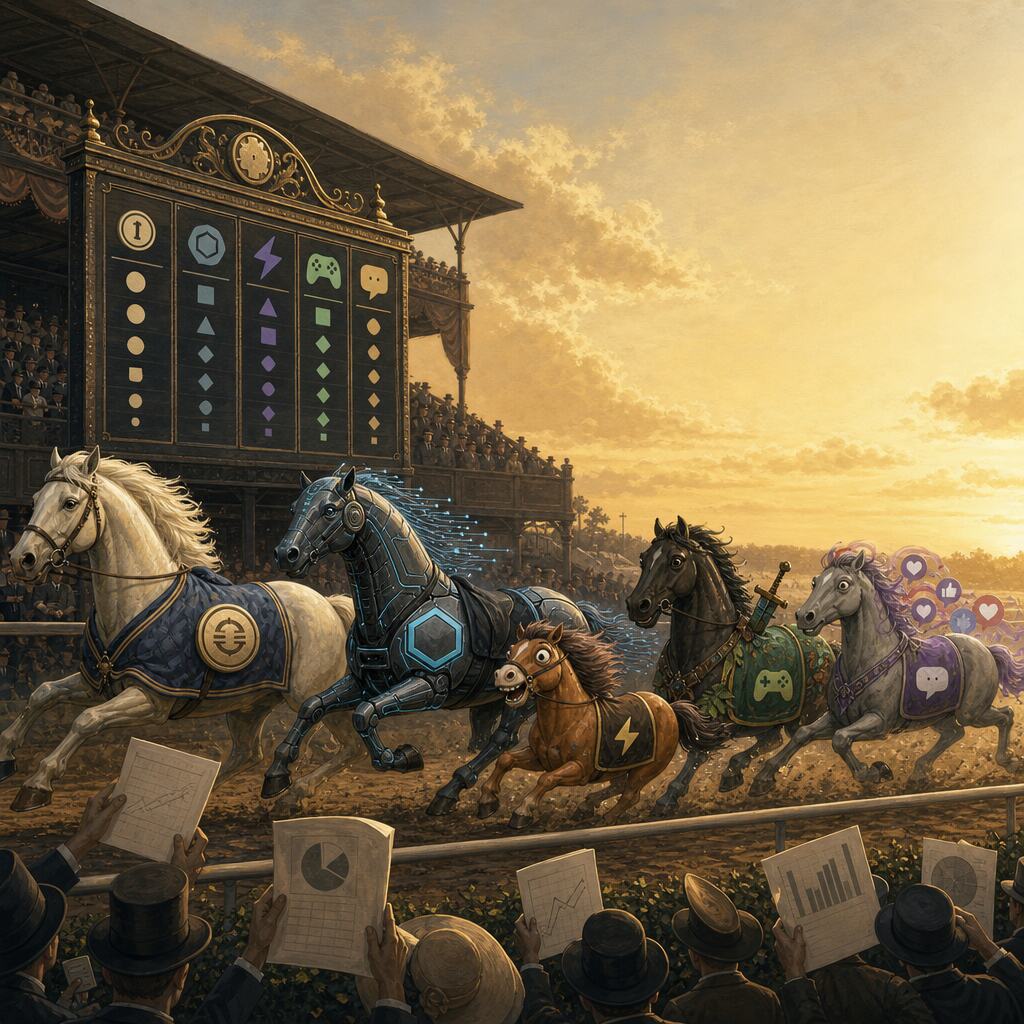
Fictional satire. The Derby, runners, odds, CryptoBookie, @LiquidityLarry, dialogue, screenshots, trades and race events are invented. Coinbase Ventures is a real venture investor but is not associated with this fictional event; no exchange listing, wrongdoing or investment outcome involving a real company is alleged. This article is commentary, not reporting or investment advice.
Welcome to the grandest spectacle in modern finance: the Coinbase Ventures Derby, where hopeful bettors gather around the paddock, study token charts instead of race forms, and put their hard-earned USDC on whichever startup has the shiniest pitch deck.
Forget horses. Horses do not have Discord servers, token unlock schedules, or a founder announcing “major partnership soon” from a hotel lobby in Singapore.
In this derby, the contenders are projects backed by Coinbase Ventures—a portfolio of crypto infrastructure companies, DeFi protocols, consumer apps, and assorted businesses attempting to place the word “protocol” after every noun. The bettors do not ask, “Is this a useful product?” They ask the only question that matters:
“When listing?”
Welcome to the track
The event begins at dawn in a Telegram group called DERBY ALPHA: NOT FINANCIAL ADVICE.
The bookmaker, known only as @LiquidityLarry, posts the morning odds:
| Runner | Odds | Form guide |
|---|---|---|
| Stablecoin Stallion | 2/1 | Has revenue, boring, suspiciously competent |
| AI x DePIN Thoroughbred | 5/1 | Whitepaper contains “agentic” 47 times |
| Perpetuals Pony | 8/1 | Promises 100x leverage with a pastel interface |
| Gaming Guild Gelding | 20/1 | “AAA-quality” trailer, gameplay unavailable |
| SocialFi Mare | 50/1 | Founder’s profile picture changed to laser eyes |
| Dog Token with a Roadmap | 100/1 | Roadmap is a JPEG of a rocket |
The seasoned gamblers nod knowingly. Coinbase Ventures has entered the arena, which means the project has received the crypto equivalent of a horse being photographed standing next to a famous jockey.
Nobody knows whether the horse is fast. But somebody important has looked at it.
And that is enough.
The bettors study the fundamentals
In traditional horse racing, analysts examine breeding, track conditions, recent performances, and the horse’s fitness.
Crypto bettors also perform rigorous diligence.
They open a spreadsheet.
They locate the Coinbase Ventures logo on a project’s announcement page.
They calculate the number of days since the “strategic investment” tweet.
Then they consult the sacred indicators:
- Number of blue-checkmark accounts replying “big if true.”
- Ratio of rocket emojis to actual product screenshots.
- Whether the project calls itself “community-owned” before distributing tokens to the community.
- How many venture funds appear in the seed-round graphic.
- Whether a Coinbase executive has liked a post at 2:13 a.m.
- The all-important “I heard something” message from an anonymous account with 83 followers.
“Strong fundamentals,” declares one bettor, after discovering that the project’s logo is purple and Coinbase’s logo is blue.
The Coinbase Ventures handicap
The Derby has its own peculiar handicapping system.
A startup that merely receives venture funding enters the race with respectable odds. A startup whose investor graphic includes Coinbase Ventures, a16z, Paradigm, a fund named after a Greek god, and a syndicate of pseudonymous angels is considered a proven champion—despite having approximately 14 users, all of whom are employees.
But not every Coinbase Ventures-backed entrant runs the same race.
Some are infrastructure projects: elegant, technical, essential, and impossible to explain at Thanksgiving dinner. Their bettors speak in hushed tones about modular execution environments, interoperability layers, sequencers, restaking, and “capturing value at the middleware level.”
These bettors have never read the documentation. They have, however, downloaded the logo in high resolution.
Other entries are consumer apps. Their backers insist they will bring “the next billion users onchain,” mostly by making users complete identity verification, bridge three assets, approve four smart-contract permissions, and pay a small fee that is only small relative to a mortgage payment.
Then there are the long shots: the projects building “the decentralized future of attention,” “the ownership layer for memes,” or “an AI-native loyalty rail for the creator economy.”
These are dangerous horses. They may either become billion-dollar networks or vanish after their community manager announces a “temporary pause while we reposition strategically.”
Betting markets for the modern degenerate
The Coinbase Ventures Derby is not limited to boring questions such as whether a project will succeed.
Modern bettors demand precision.
At CryptoBookie, you can place wagers on:
- Whether a token will launch before the product.
- Whether the project’s token ticker will accidentally spell something embarrassing.
- Whether “fair launch” means fair to the people who received tokens before anyone else knew the project existed.
- Whether the community vote will approve the proposal backed by 72% of the circulating supply held by early investors.
- Whether the token will rise 300% before anyone figures out what it does.
- Whether the chart will later be described as “healthy consolidation.”
- Whether a Coinbase Ventures logo will be removed from the website after someone asks an inconvenient question.
- Whether the founder will say “we’re focused on the long term” within 24 hours of a 70% drawdown.
The most popular market, naturally, is called The Listing Exacta:
- Project receives Coinbase Ventures funding.
- Crypto Twitter begins using “Coinbase-backed” as a substitute for analysis.
- Token launches or rumors of a listing emerge.
- Everyone buys at once.
- Someone posts a chart with the caption “zoom out.”
- The original investor announcement is rediscovered and reposted as if it happened that morning.
Inside the paddock
Before the race, every project gets a chance to impress the crowd.
Stablecoin Stallion walks calmly around the ring, generating fees, serving users, and quietly solving a real payments problem. The audience is unimpressed.
“Where is the narrative?” they ask.
AI x DePIN Thoroughbred enters wearing a smart collar connected to three blockchains. Its team explains that it will coordinate unused GPU capacity, real-world devices, autonomous agents, and possibly your refrigerator.
The audience erupts.
“Finally,” says a bettor, “a project with fundamentals.”
“What does it do?” asks someone else.
“It has a partnership with a company that has a partnership with a company that uses AI.”
All bets are placed.
Perpetuals Pony trots in next. It offers leverage so high that a one-cent market movement can convert a sophisticated thesis into a life lesson. Its fans praise it as “capital efficient.”
The horse sneezes. Forty-seven wallets are liquidated.
Meanwhile, Gaming Guild Gelding promises to revolutionize digital entertainment, provided the game eventually ships, the token economy survives, the marketplace works, the servers stay online, and players can be persuaded that earning fractions of a token is more fun than simply playing a game.
The odds move dramatically after a popular influencer tweets: “This one feels different.”
No one asks different from what.
Some horses never reach the starting gate
In this fictional Coinbase Ventures stable, some horses are sent to the slaughterhouse before the Derby even starts. No animals are involved: this is a deliberately harsh metaphor for an imaginary project being shut down before delivering its promised product.
The crowd has already bought the tokens. The horse has already appeared in the funding announcement. The bettors have already framed the investor-logo graphic.
Then an imaginary stable notice appears:
“After careful consideration, we have decided not to proceed with the race. Thank you for believing in the journey.”
“What happens to the horse?” asks a token buyer.
“The project is discontinued.”
“What happens to our tokens?”
“You keep them. Ownership is very important to us.”
The fictional betting screen marks this runner’s token $0. No redemption. No consolation prize. Just a souvenir of a race that never happened.
“So the horse is gone, the race is cancelled, and we’re left holding something with no value?”
“Please don’t call it being dumped,” says the imaginary stable announcer. “Call it a permanent allocation to the community.”
The backer’s logo was on the entrance. The token buyer is left at the exit.
This scene, the decision attributed to the fictional stable, and the zero-dollar token are invented—not evidence that Coinbase Ventures ordered a real shutdown or sold tokens onto buyers. In actual projects, closing a business does not automatically make every associated token worth exactly zero; market price, liquidity, redemption rights and any remaining utility must be checked separately. Nor does backing a project, by itself, establish control over its closure or a duty to repay token holders.
The race begins
The starter’s pistol fires.
Stablecoin Stallion moves steadily out front, earning modest applause from people who apparently enjoy durability, compliance, and cash flow. These people are immediately muted.
AI x DePIN Thoroughbred leaps ahead after a rumor circulates that “Tier-1 exchange discussions are advanced.” Nobody knows who started the rumor. It has already been translated into six languages and presented as research.
Perpetuals Pony sprints wildly, fueled by liquidity incentives and trader optimism. Its token rises 80% in an hour, prompting headlines that it has “validated product-market fit.”
Then the incentives expire.
The crowd watches as the pony discovers gravity.
At the halfway mark, a Coinbase Ventures portfolio page is updated. No project is added. No token is mentioned. No official announcement occurs.
But a blurry screenshot circulates anyway.
The bettors react as professionals do: they buy first and ask whether the screenshot was real after the candles turn red.
The post-race analysis
By sunset, the winner is declared—not the project with the most users, the strongest technology, or the clearest business model, but the one whose token briefly produced the most impressive green candle before returning to approximately where it began.
Analysts gather to explain the outcome.
“The market is irrational,” says a trader who bought after a 240% move.
“Smart money knows something,” says an account whose entire evidence is a cropped investor graphic.
“Coinbase Ventures-backed projects always do well,” says another, excluding the projects that did not, because those were “not real Coinbase Ventures plays.”
This is the central miracle of the Derby: every winning bet proves genius, every losing bet was manipulated, and every project remains “early” until further notice.
A responsible betting guide
For anyone tempted to wager on the next Coinbase Ventures-backed runner, here is the traditional Derby advice:
- A venture investment is not the same thing as a promised exchange listing.
- A recognizable investor can be a useful signal, but it is not a substitute for understanding the product, token economics, valuation, competition, unlocks, or legal risks.
- “Backed by” may describe an investment relationship, not an endorsement of every token, product claim, or future price movement.
- A polished funding announcement can coexist with a weak product, thin liquidity, or a very expensive token.
- If your entire thesis fits inside the phrase “Coinbase Ventures invested,” you are not conducting research. You are betting on the color of the jockey’s silk.
And remember: in horse racing, at least the horses are honest about what they are trying to do. They run very fast in a circle.
In crypto, the horses explain they are building an interoperable, composable, permissionless circular-running primitive—then ask you to stake your tokens for governance rights.
Place your bets accordingly.